What Is a 51% Attack in Blockchain Technology?
What is a 51% attack in blockchain technology? It lets one group rewrite recent blocks. Here is what it can and cannot do, and why it is rare.
Quick Answer
A 51% attack in blockchain technology happens when an attacker gains majority control of a proof-of-work network's mining power, potentially allowing them to reorganize recent transactions and reverse their own payments. The attack does not automatically give them access to other users' wallets or allow them to create coins without following the protocol's rules.
A 51% attack in blockchain technology occurs when an individual or group controls more than half of a proof-of-work network’s total mining power. This advantage can allow attackers to reorganize recent blocks, reverse their own transactions or disrupt transaction confirmation but it does not automatically let them steal other users’ funds.
Major Takeaways
Understand how majority mining power can enable transaction reversals and recent chain reorganizations.
Recognize that attackers cannot automatically steal private keys or spend other users' funds.
Know how attack costs depend on mining hardware, electricity and available network hash power.
Learn how exchanges respond by increasing confirmations, pausing deposits or reviewing affected transactions.
What Majority Control Actually Buys
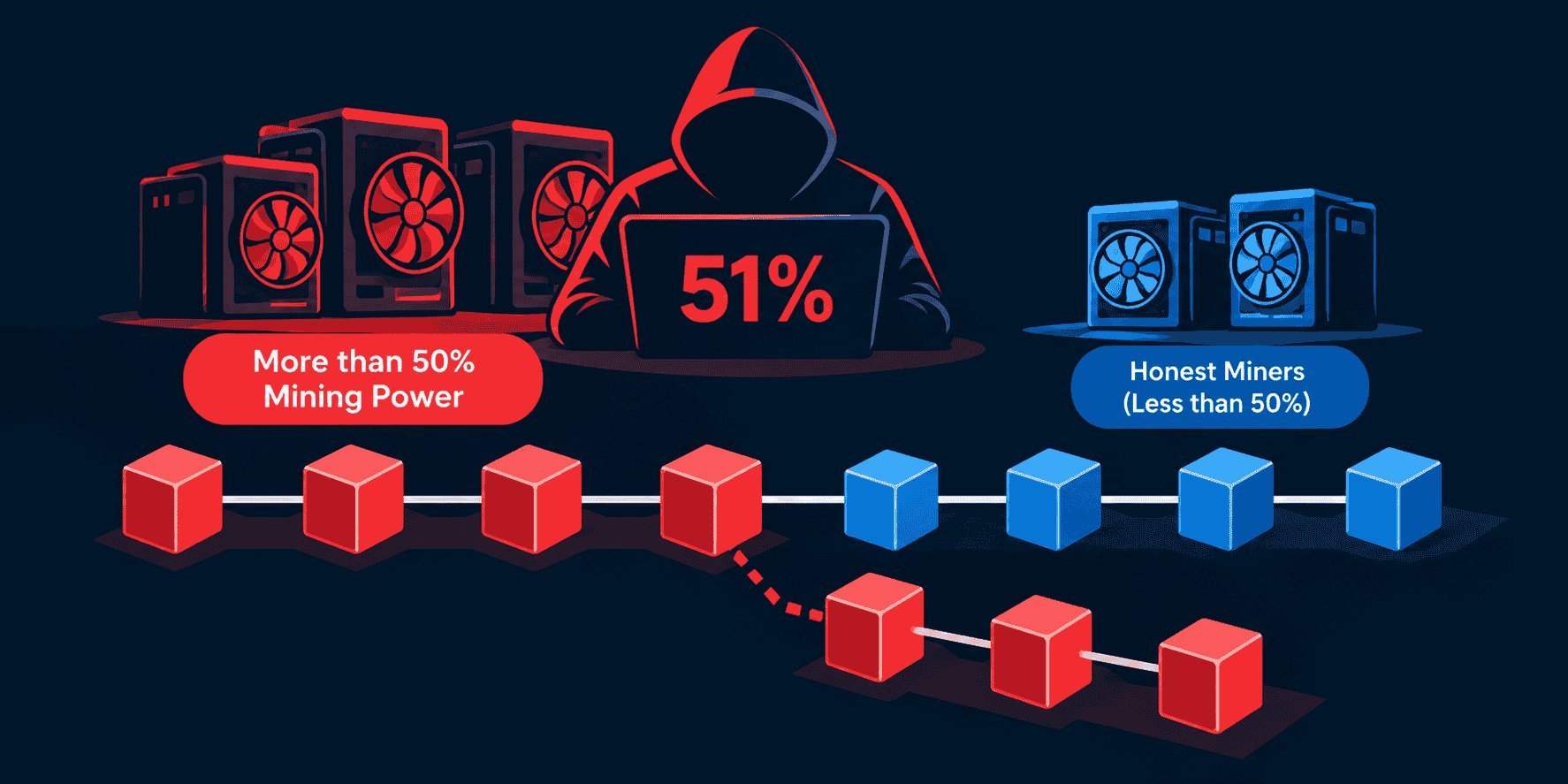 Caption: 51% Blockchain Attack Illustration
Alt text: 51% blockchain attack illustration showing majority mining power and competing blockchain.
What is a 51% attack in blockchain technology? A 51% attack is an attack on consensus (the mechanism by which a blockchain reaches agreement on the transaction history). In a proof-of-work system miners are competing to produce valid blocks. If an attacker controls the majority of the network's hash power they can use that to their advantage in building an alternative chain.
This type of blockchain attack is also called a majority attack crypto events. Its impact depends on the network's design, the attacker's resources and how much transaction history is affected.
What an Attacker Can Do
With the majority of the hash power an attacker could in principle reorganize recent blocks and reverse their own transactions. The classic example would be to send some coins to a trading platform, get an asset or service in return and then attempt to reorganize the chain to effectively remove that transaction from the history (i.e. the payment to the trading platform).
This chain reorganization attack could in principle allow for a double spend if the alternative chain is accepted by the network.
What an Attacker Cannot Do
Majority hash power does not in itself allow an attacker to steal coins from any old wallet, discover private keys or make an unlimited number of coins. The transactions still have to be valid according to the protocol.
The attacker also can't be certain that every node, every exchange and every service will accept the reorganized chain. Network participants may well go into defense mode, change their software or simply impose more stringent confirmation requirements.
The Cost: Hardware, Energy, Opportunity
The cost of a 51 percent attack is a function of the total hash power of the network, the amount of mining hardware available, the cost of electricity and the length of time the attack is going to take. For some networks it may be possible to rent the requisite amount of computing power and for others the cost would be astronomical.
There are also the indirect costs (lost mining revenue, price effects and the risk that an attack will damage confidence in the network). Smaller Pow chains can be more vulnerable in that their total hashrate may be more easily matched or exceeded.
How Exchanges and Chains React
The major exchanges may suspend deposits and withdrawals for the affected asset, may increase their confirmation requirements or may carry out an investigation into unusual reorganizations. They may also delay crediting of deposits while they check that the transaction has remained confirmed.
Before trading, understand how transactions and orders work. This guide on how to read an order book explains bids, asks and market depth, while what is cryptocurrency spot trading covers the basics of buying and selling digital assets.
Why Small Chains Are More Exposed
A smaller proof of work network will have fewer miners and less total hash power securing its history. An attacker with sufficient computing power may therefore be able to achieve majority control more easily than they would on a large, widely distributed network.
However network size on its own doesn't dictate security. Mining concentration, hardware availability, consensus design and the behavior of the exchanges and node operators all come into it.
Conclusion
A 51 percent attack uses control of the proof-of-work consensus to potentially reorganize the recent transaction history. It doesn't in any way automatically break the cryptography or give you unbounded control over the funds. You judge a blockchain on its security budget and its network design, not on the marketing. To explore available cryptocurrency markets, visit XXKK Markets or create an XXKK account.
FAQs
What is a 51% attack in blockchain technology?
A 51% attack is when an attacker controls the majority of the mining power on a proof of work blockchain. This gives them the ability to reorganize recent blocks and in theory could allow them to reverse their own transactions.
What can an attacker do with majority hash power?
An attacker with majority hash power could potentially reorganize the recent blocks, exclude certain transactions from their alternative chain and attempt a double spend. This is not guaranteed to work. They still have to produce valid blocks and the exchanges or the network participants may well reject the deposits or take some protective action.
What can they not do?
A majority attacker cannot just go out and steal funds from any old wallet, can't recover private keys and can't just create an unlimited supply of coins outside the rules of the protocol. What majority hash power gives you is influence over the order of transactions and the confirmation history. Other nodes on the network are also free to reject the chain that the attacker wants to have.
How expensive is a 51% attack?
The cost will vary depending on the network's hash power, the hardware available, the cost of electricity and the length of the attack. A smaller network may be cheaper to attack than a large one.
How do exchanges respond?
The major exchanges may suspend deposits and/or withdrawals, may require more transaction confirmations and may investigate chain reorganizations. They may well delay crediting of deposits until the chain history is clearer. The response will be different depending on the blockchain in question and the exchange's own risk protocols.
