Components of Blockchain: Blocks, Nodes and Keys
A plain breakdown of the components of blockchain: blocks, chains, nodes, consensus rules and keys, and what each part actually does.
Quick Answer
The main components of blockchain are blocks, a linked chain, nodes, consensus rules, and cryptographic keys. For anyone asking “what is the role of a node,” a full node checks ledger data against the network’s rules. Together, these parts organize transactions, coordinate an accepted history, and let users authorize actions without exposing their secret keys.
The phrase "components of blockchain" is a collective label for the structures, participants, rules, and cryptographic tools that maintain a shared ledger. Blocks organize transactions, hashes connect records, nodes check data, consensus coordinates the accepted history, and keys authorize actions. Implementations differ across networks, but these roles explain the basic design.
Major Takeaways
Blocks group transaction data, while hashes make changes to linked records detectable.
Full nodes independently check validity; producing blocks is a separate network role.
Consensus mechanisms coordinate accepted history, while private keys authorize actions through digital signatures.
An address identifies a destination; it does not reveal the private key controlling it.
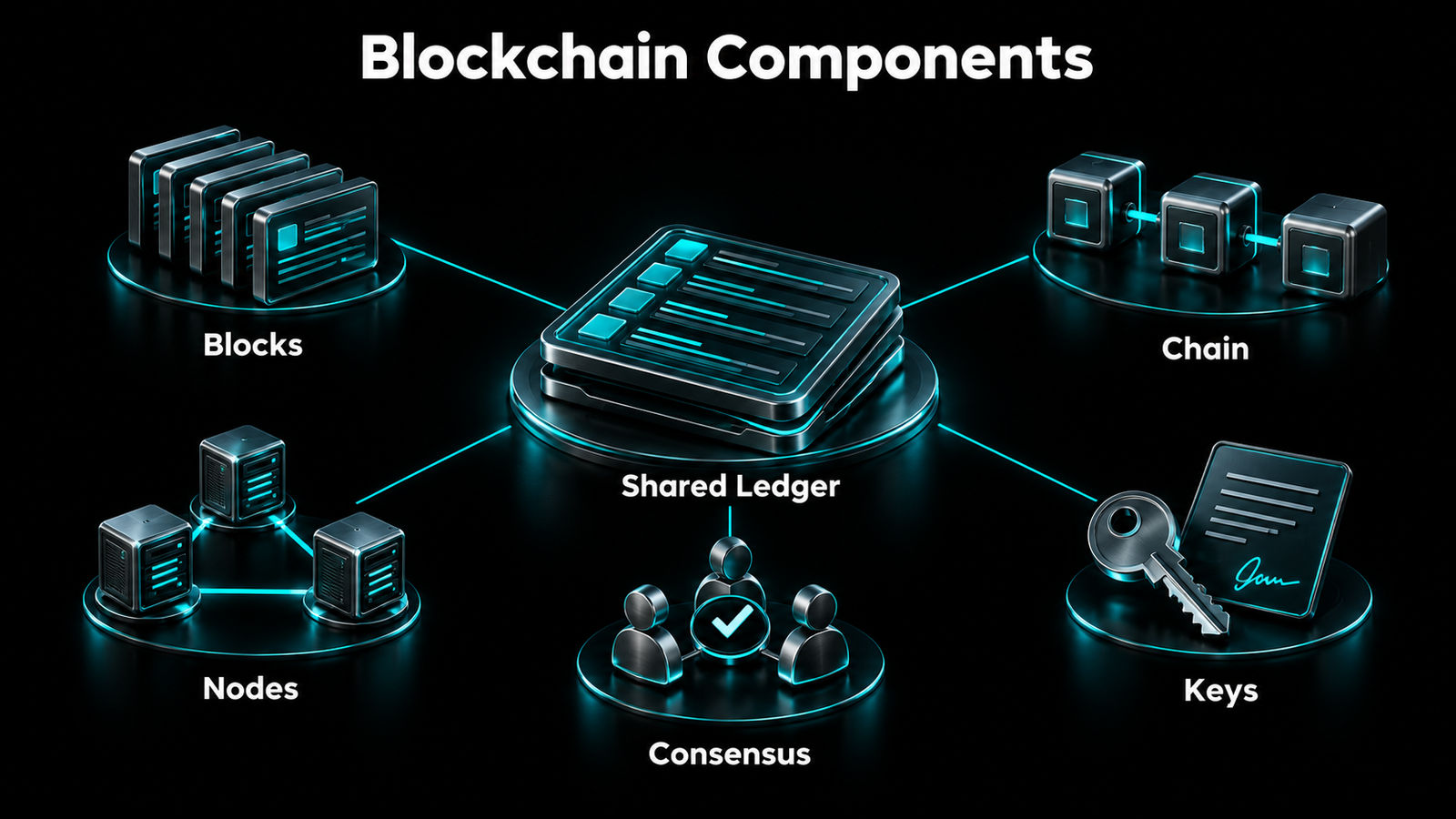 The Five Parts of a Blockchain
To answer “what are the main components of blockchain,” consider how blocks, the chain, nodes, consensus rules, and keys maintain a shared ledger. This overview maps their roles in blockchain architecture; individual networks implement them differently.
Blocks package transactions and metadata; the blocks documentation expands on their layout.
The chain orders linked records; the blockchain developer guide explains the connections.
Nodes maintain network participation; the nodes and clients guide explains their different roles.
Consensus rules coordinate agreement; the consensus mechanisms guide explains how networks choose an accepted history.
Keys authorize actions, and addresses identify destinations; the accounts and key pairs guide explains the relationship.
Consensus ties the map together. Validity rules define acceptable transactions and blocks, while consensus mechanisms coordinate the accepted sequence. Proof of work and proof of stake use different approaches to block production and agreement. Neither replaces the checks that participating full nodes perform.
Blocks: Header, Transactions and Hashes
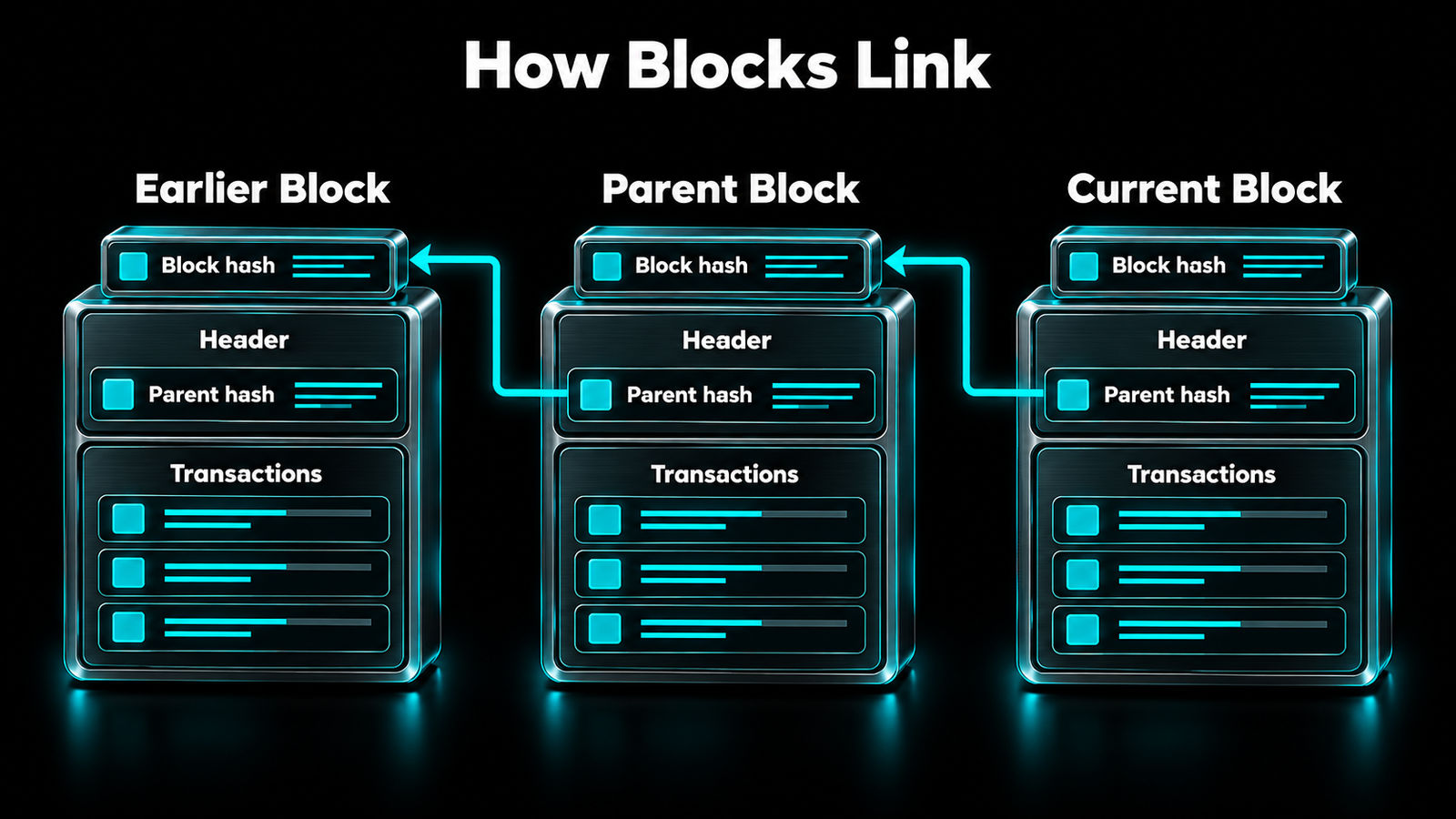
A typical block structure contains a header and a body holding transactions. The header includes metadata and references that help identify the block and connect it to earlier history. Exact fields vary by network; there is no universal block layout.
A hash is a digital fingerprint calculated from data. Changing the input changes the resulting hash with overwhelming likelihood. Headers commonly include a commitment to transaction data, such as a Merkle root. This supports checking whether data matches the recorded commitment; it does not encrypt the transactions or make them private.
Nodes: Who Stores and Validates
A node in a blockchain is an instance of network software communicating with peers. Full nodes independently check transactions and blocks against protocol rules. Storage differs: a pruned node can validate the chain while discarding older block data after processing it.
Light clients use less data and rely on additional assumptions or proofs. A miner or validator may propose blocks under the network’s consensus mechanism, but simply running a full node does not automatically give it that role. Distinguishing verification, storage, and block production prevents a common vocabulary mix-up.
The Chain: How Blocks Link Backwards
In the blockchain data structure, each ordinary block references its parent through a hash. The first block is the starting point rather than a link to an earlier block. Following parent references lets software trace a branch backward through history.
Changing an old record disrupts the commitments linking it to later records. That makes alteration detectable; hashes alone do not decide which history wins. Nodes also apply consensus rules when competing branches appear. Replacing accepted history would require overcoming the network’s consensus protections, not merely editing a stored file.
 Keys and Addresses: Who Owns What
For a key-controlled account, a private key creates digital signatures that authorize transactions. The corresponding public key allows verification. An address is a network-specific identifier used for receiving assets or interacting with accounts and contracts; it is not simply another name for a public key.
A wallet manages keys and helps construct transactions. The assets remain represented in the ledger, rather than being stored inside the wallet application. Control of a signing key establishes the ability to authorize actions, not necessarily someone’s legal ownership. Never share a private key with anyone, including support.
Reading a Block Explorer Without Guessing
A block explorer presents ledger records in a searchable interface. Begin by selecting the correct network, then search for a transaction hash, block identifier, or address. These identify different objects; an address is not a transaction receipt.
For a transaction, check status, inclusion in a block, sender, recipient, and network fee. A pending entry has not necessarily been included, and inclusion is not always finality. On networks that show execution status, inclusion can coexist with failed execution. A block’s height describes its position in the chain; its hash identifies that particular block.
A block explorer is not a price chart. For the trading vocabulary, use Candlestick Chart Basics and What Is Cryptocurrency Spot Trading; for market context, visit XXKK Markets. Keep ledger activity separate from market-price information.
Conclusion
Start with the vocabulary, then read the component deep dives. Trace one public transaction from its identifier to its block, and distinguish the addresses from the keys that authorize actions. Create an account on XXKK to explore crypto markets with a clearer understanding of what the underlying ledger records.
FAQs
What are the main components of blockchain?
The core parts are blocks, the chain linking them, nodes, consensus rules, and cryptographic keys. Blocks organize records, nodes check data, consensus coordinates the accepted history, and keys authorize transactions. This is a learning framework rather than a claim that every network has an identical design.
What is inside a block?
A block generally holds transactions and a header containing metadata and cryptographic references. When asking what is inside a block, distinguish its transaction body from fields that identify it or connect it to history. Specific fields depend on the network. Block data is public; the private key never appears there.
What is the role of a node?
A node participates in the network by running protocol software and communicating with peers. Full nodes independently verify transactions and blocks, while storage and other responsibilities depend on configuration. A node can check validity without producing blocks, and a pruned node need not retain every old block file.
How are blocks linked together?
Blocks normally link through a reference to the previous block’s hash. Because that hash depends on the referenced data, altering history breaks the expected connections. The network also needs consensus rules to select the accepted branch; hash links alone do not settle disagreements or make rewriting history impossible.
What do public and private keys do?
Private keys generate signatures authorizing actions, while public keys help verify those signatures. Addresses identify destinations using the network’s addressing rules. For key-controlled accounts, protecting the private key protects the ability to authorize transactions. Sharing an address for receiving assets does not require sharing its private key.
