Crypto Currency: What It Is and How It Works
A crypto currency is a digital asset recorded on a ledger. This guide covers how it works, what backs it, and the risks that come with holding it.
Quick Answer
A crypto currency is a digital asset that uses cryptography and a distributed ledger to record ownership and transactions. It allows people to transfer value across networks without relying on a traditional bank to process every transaction. Understanding wallets, private keys, supply and market value helps explain how these assets work.
A crypto currency is a digital asset whose ownership is recorded on a shared ledger and transferred between users through a blockchain or similar network. It is not automatically a claim on a company or government and it is not the same as money issued by a central bank.
Major Takeaways
-
Understand how cryptocurrencies use distributed ledgers to record transactions and maintain ownership records.
-
Private keys authorize transactions and provide control over assets held at blockchain addresses.
-
Market value depends on supply, demand, utility, adoption and confidence in the network.
-
Stablecoins aim to maintain price stability but carry issuer, reserve and operational risks.
Understand how cryptocurrencies use distributed ledgers to record transactions and maintain ownership records.
Private keys authorize transactions and provide control over assets held at blockchain addresses.
Market value depends on supply, demand, utility, adoption and confidence in the network.
Stablecoins aim to maintain price stability but carry issuer, reserve and operational risks.
What a Crypto Currency Actually Is
A crypto currency is a digital asset designed to operate through cryptographic systems and distributed networks. Instead of relying entirely on a central institution to maintain transaction records, many cryptocurrencies use blockchain technology. A blockchain is a type of distributed ledger. It records transactions in connected blocks that network participants verify according to established rules.
When someone sends cryptocurrency, the network checks the transaction before recording it. Depending on the blockchain, this verification might involve miners, validators or another consensus mechanism. For example, suppose Alice wants to send Bob 0.01 Bitcoin.
-
Alice enters Bob's wallet address and the amount.
-
Her wallet uses her private key to authorize the transaction.
-
The transaction is broadcast to the Bitcoin network.
-
Network participants verify it against the blockchain's rules.
-
The transaction is included in a block and recorded on the ledger.
Bob's wallet then reflects the updated balance after the transaction receives the required network confirmation. The process does not require a traditional bank to update a central account balance. However, users still depend on network infrastructure, wallet software and the security of their private keys.
Coins, Tokens and Stablecoins
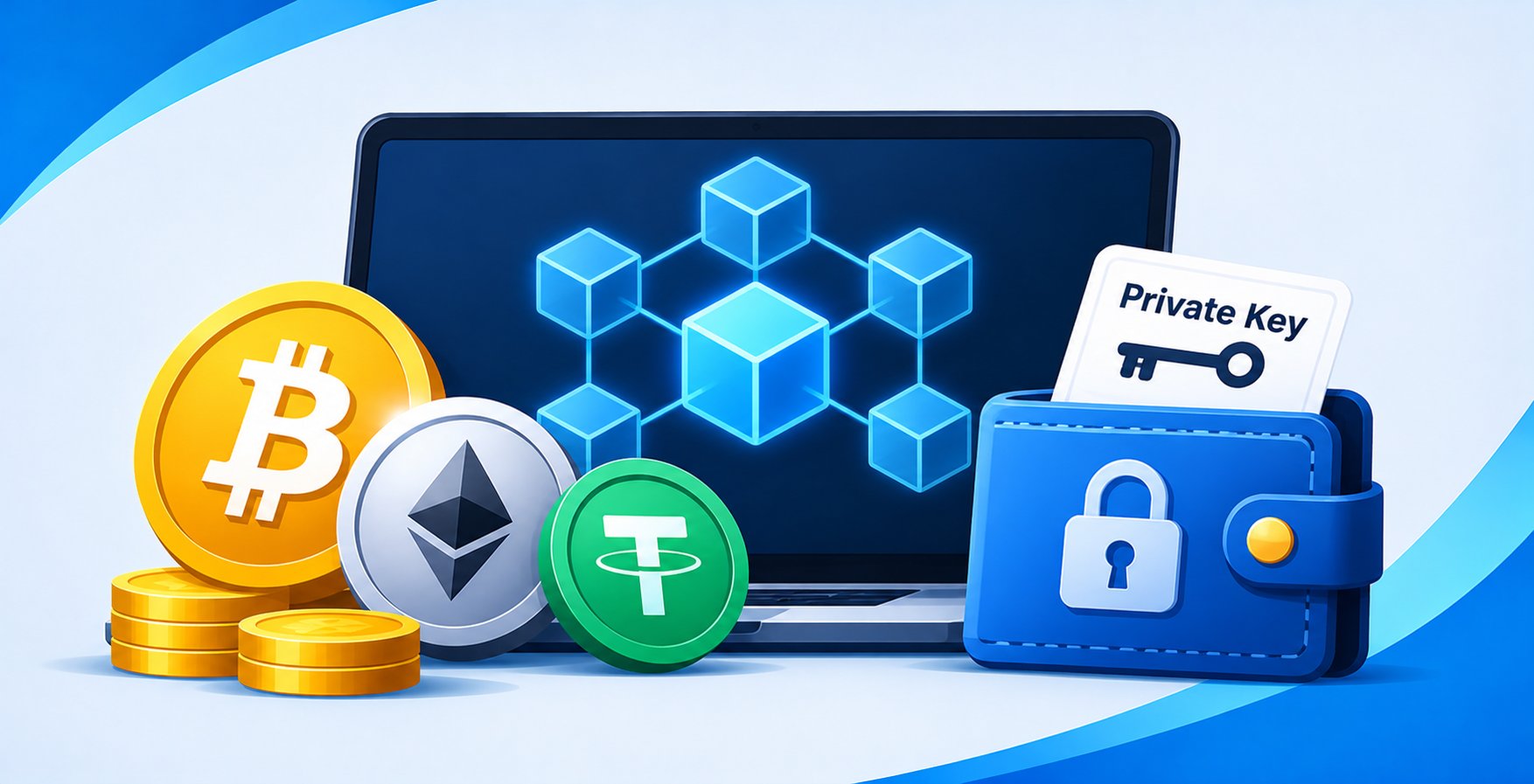 Caption: Cryptocurrency, blockchain technology, digital assets and private key security.
Alt-text: Cryptocurrency illustration featuring Bitcoin, Ethereum, a blockchain network and a secured digital wallet.
Not every crypto asset works in the same way. Understanding the difference between coins, tokens, and stablecoins helps explain their roles.
Coins: A coin is the native asset of its own blockchain. For example, Bitcoin operates on the Bitcoin network, while Ether is the native asset of Ethereum. Coins often support network fees, transaction settlement, staking or other functions.
Tokens: A token is a digital asset created on an existing blockchain. It might represent access to a service, governance participation, a digital item or another form of value. Tokens depend on the underlying blockchain for transaction processing and security. Their functions and rights depend on the smart contracts and project rules behind them.
Stablecoins: A stablecoin is a cryptocurrency designed to maintain a relatively stable value against another asset, commonly a fiat currency such as the US dollar. Some stablecoins use reserves, while others rely on crypto collateral or algorithmic mechanisms. Their designs differ and each introduces specific risks. Stablecoins are not identical to cash held in a bank account. Their value depends on the mechanism supporting the peg, reserve quality, redemption arrangements and the issuer or protocol.
Where Ownership Is Recorded
Cryptocurrency ownership is recorded on the blockchain or another distributed ledger. It is not stored inside a wallet in the same way physical cash is stored in a purse. A crypto wallet manages the keys used to access and authorize transactions associated with blockchain addresses. The most important key types are:
-
Public key: Used to derive an address or verify digital signatures.
-
Wallet address: The destination identifier used when receiving cryptocurrency.
-
Private key: A secret cryptographic key used to authorize transactions.
Anyone who controls the relevant private key generally has control over the associated assets. Losing access to the key or recovery phrase might make those assets permanently inaccessible. Wallets come in different forms. Software wallets operate on phones, computers or browsers. Hardware wallets keep private keys in dedicated devices. Custodial platforms hold keys on behalf of customers.
With a custodial service, users rely on the provider to manage access and process withdrawals. With a self-custody wallet, users take responsibility for protecting their keys. Store your keys where you control them and never share your recovery phrase with another person.
What Gives It Value
Cryptocurrency value comes from several factors. There is no single formula that determines what every digital asset should be worth. Some of the important factors include:
Supply: The number of tokens available and the rules governing new issuance influence scarcity.
Demand: Buyers create demand based on perceived usefulness, market expectations and willingness to hold an asset.
Utility: Some assets support transaction fees, network operations, applications or governance functions.
Adoption: Network usage, developer activity, integrations and user participation influence how an ecosystem develops.
Market confidence: Public perception, security, transparency and project credibility affect demand.
Market capitalization, often called market cap, is calculated by multiplying an asset's current price by its circulating supply. For instance, if a cryptocurrency trades at $2 and has 10 million circulating tokens, its market cap is $20 million. Market cap provides a way to compare asset valuations. However, it does not represent the amount of money invested in the project or the cash available to holders.
Visit XXKK Markets to explore available crypto markets or go to XXKK Home to create an account.
Main Risks Holders Accept
Cryptocurrency ownership involves risks beyond ordinary price movements.
-
Price volatility: Prices might rise or fall sharply within short periods.
-
Private key loss: Lost or stolen keys might result in permanent loss of access.
-
Security vulnerabilities: Wallets, exchanges, bridges and smart contracts might experience attacks or technical failures.
-
Liquidity limitations: Some assets have limited buyers and sellers, making large trades difficult to execute at expected prices.
-
Regulatory changes: New rules might affect trading, custody, transfers or access to certain services.
-
Project failure: A cryptocurrency project might lose users, funding, developers or operational support.
-
Stablecoin risks: Reserve problems, redemption restrictions or technical failures might cause a stablecoin to lose its intended peg.
No cryptocurrency is automatically safe because it uses blockchain technology. Users need to understand the risks associated with the asset, network, wallet and platform they choose.
How to Check a Coin Before Buying
Research the asset before making a purchase. A simple review helps identify weaknesses that a promotional description might leave out. Use this checklist:
-
Understand its purpose: Find out what the cryptocurrency does and why its network needs the asset.
-
Check circulating supply: Review total supply, maximum supply, issuance rules and upcoming token unlocks.
-
Review holders: Examine token distribution and identify large wallet concentrations where reliable data is available.
-
Check network activity: Look at transaction activity, active users and developer updates.
-
Review liquidity: Compare trading volume, order book depth and available trading pairs.
-
Read the documentation: Understand the project's technology, governance, tokenomics and security arrangements.
-
Check where it trades: Verify the exchange, trading pair, withdrawal support and applicable fees.
Start with the mechanics, then the market. Check supply and holders before you buy. For a practical introduction to buying and selling digital assets, read Spot Trading Basics. You can also explore broader developments in the Crypto Market Outlook 2026.
Conclusion
A crypto currency is a digital asset that uses cryptography and distributed networks to record and transfer value. Coins, tokens and stablecoins serve different purposes, while private keys determine who controls access to assets. Before buying, understand how the network works, examine supply and holders and assess security and liquidity. Knowing the mechanics helps you evaluate an asset beyond its price or popularity.
FAQs
What is a crypto currency?
A crypto currency is a digital asset that uses cryptography and a distributed ledger to record transactions and ownership. It operates through a blockchain or similar network rather than relying entirely on a central bank or payment provider. Examples include Bitcoin, Ether and various blockchain-based tokens.
How does it differ from fiat money?
Cryptocurrency operates through digital networks and cryptographic systems, while fiat money is issued by a country's central bank or monetary authority. Fiat currency is commonly used for everyday payments and supported by government monetary systems. Cryptocurrencies follow network-specific rules for issuance, transfers and validation, with values determined by market conditions.
Where is it actually stored?
Cryptocurrency ownership is recorded on a blockchain or distributed ledger, rather than stored inside a wallet as a physical object. Wallets manage the private keys used to access and authorize transactions. A custodial platform manages keys on behalf of customers, while self-custody wallets leave key management with the user.
What gives it value?
Cryptocurrency value depends on supply, demand, utility, adoption, network activity and market confidence. Some assets support transaction fees or network operations, while others provide access to applications or services. Market capitalization combines circulating supply and market price, but it does not measure the amount of money invested in an asset.
What makes silver different from gold?
Silver differs from gold in its industrial applications, market demand, and price behavior. Silver is widely used in electronics, solar panels and manufacturing, while gold has stronger demand from jewelry, investment and central bank reserves. Silver prices often respond more directly to changes in industrial activity and economic demand.
