PoW and PoS in Blockchain: Energy and Security
PoW and PoS in blockchain secure a network in different ways. Here is how each spends a resource, and what that means for energy and control.
Quick Answer
PoW and PoS in blockchain are two consensus mechanisms that help networks agree on valid transactions and protect their ledgers from attacks. Proof of Work relies on computational power and electricity, while Proof of Stake relies on cryptocurrency committed by validators. Both aim to secure a blockchain but they use different resources and have different risks.
Proof of Work (PoW) and Proof of Stake (PoS) are blockchain consensus mechanisms that determine how transactions are verified and how networks agree on their shared records. PoW uses computational work to compete for block production while PoS uses staked assets and validator rules to participate in consensus.
Major Takeaways
Proof of Work uses computational power and electricity to make attacks costly for participants.
Proof of Stake requires validators to commit assets and follow protocol rules to earn rewards.
Both consensus models face security risks that depend on incentives, network design and decentralization.
Energy use differs significantly but neither mechanism guarantees security or fairness on its own.
Two Ways to Buy Security
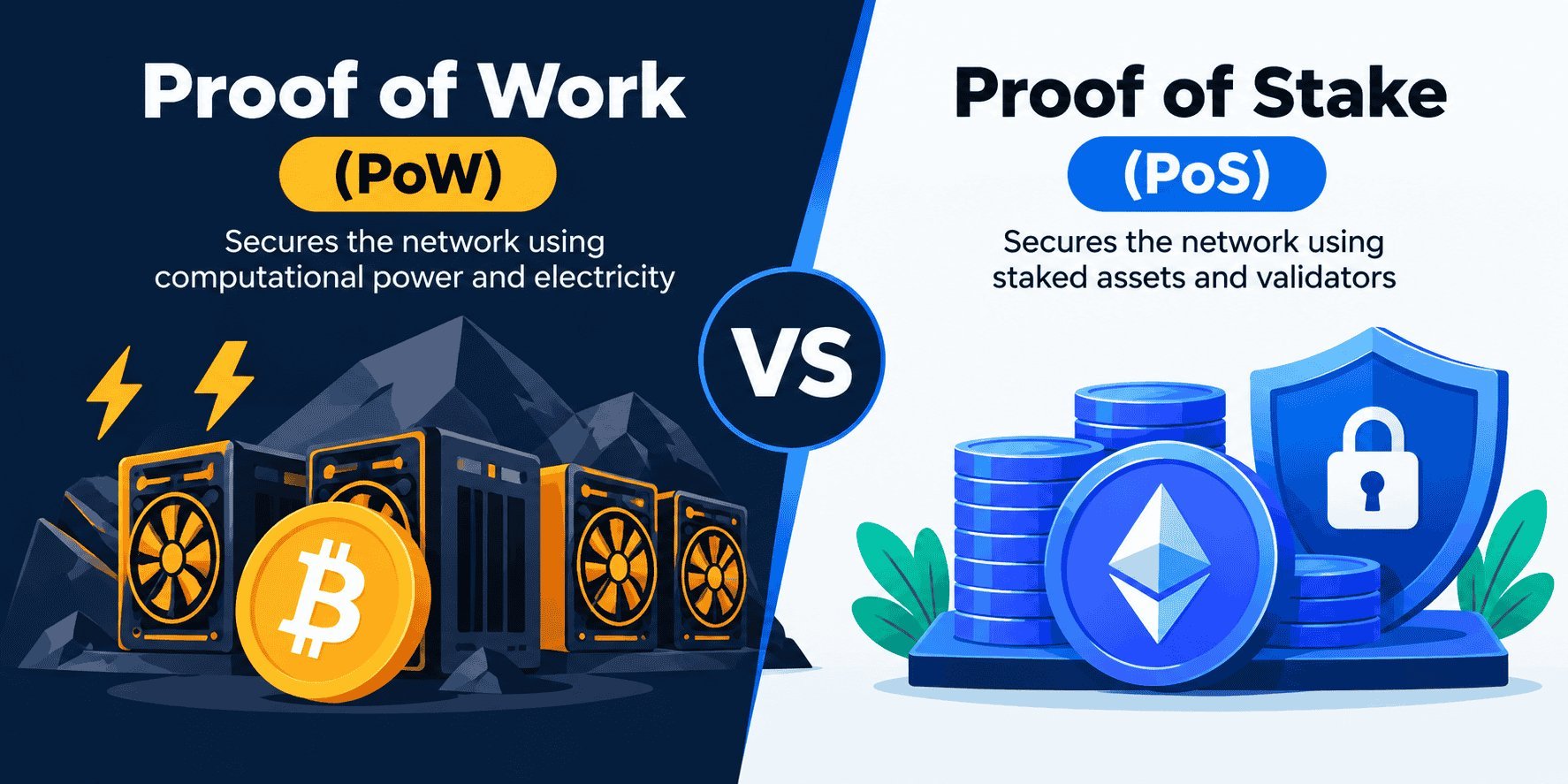 Caption: PoW and PoS Blockchain Illustration
Alt text: Proof of Work mining hardware and Proof of Stake validators
Blockchains need some way for independent participants to agree on which transactions are valid without having to go through a central authority. The consensus mechanisms are what coordinate that process and make it expensive or risky to try and subvert the network.
In proof of work vs proof of stake, the key difference is the resource participants must commit to help secure consensus. PoW requires computational work, while PoS requires financial capital. Neither approach eliminates risk and their security depends on how each network implements its rules.
Proof of Work: Paying in Energy
Proof of Work miners use either specialized hardware or general-purpose hardware to solve the computational puzzles. The network will accept a block in accordance with its protocol rules and the miner who has successfully solved the puzzle will be rewarded.
This process uses electricity as the mining hardware has to do a lot of calculations. Competition can drive miners to buy more hardware which in turn will increase the total amount of electricity consumed by the network.
The energy expenditure is part of the PoW security model. An attacker who wanted to go after block production would be required to have a lot of computing power and a lot of electricity to run it. The cost and difficulty of the attack will obviously vary depending on the hardware available, the level of network participation and all the other factors.
Proof of Stake: Paying in Capital
Proof of Stake replaces the competitive mining model with validators who stake their own cryptocurrency in order to take part in the consensus process. The protocol will then select which validators get to propose or confirm blocks in accordance with its rules.
Validators can be rewarded for doing their jobs properly. Depending on the protocol they are operating under they can lose some of their staked assets via slashing if they breach certain rules (e.g. by signing two different messages).
This changes the security incentives completely. Instead of just relying on the cost of electricity (as in Pow), PoS uses financial penalties and validator rules to deter attacks.
Attacks: Cost, Slashing and Recovery
Consensus security is all about how hard it is to manipulate the network and how well the protocol deals with things going wrong.
In PoW an attacker would need a lot of computing power to reorganize the recent blocks or to censor transactions. In PoS an attack may require a lot of stake or may be based on some weakness in the way the validators cooperate. Slashing will discourage some of the bad behavior but won't stop every possible attack.
Recovery is also different. Networks can have a range of options for how they respond to a serious incident, from following protocol rules through to software updates, validator coordination and community consensus. Each of those responses will involve some form of trade-off.
Energy, Decentralization and Hardware
The Pow vs Pos debate is frequently all about electricity, but energy is only one of the factors. PoW can favor those with access to efficient hardware, cheap power and the right kind of infrastructure. That in itself can be a barrier to entry and can have an effect on where the mining actually takes place.
PoS reduces the need for energy-intensive mining, but staking can also lead to concentration of influence in the hands of the large holders, the custodians or the professional validators. The ability to participate will of course depend on the requirements of the network and how staking is set up. When comparing mining vs staking, consider resource costs, barriers to participation, incentives and who can influence consensus.
Reading the Debate Without Taking Sides
Energy consumption on its own doesn't tell you whether a blockchain is secure. You have to look at the cost of an attack, the distribution of miners or validators, the penalty rules and the way the network deals with failure.
If you are learning how to use crypto markets, explore our guides to cryptocurrency spot trading and our beginner guide to crypto wallets. You can also review XXKK Markets to explore available markets.
Conclusion
PoW and PoS both provide security in the form of a fee, but they do so in very different ways. PoW is all about computational work and electricity. PoS is all about committed capital and protocol-based incentives. The relative strengths and weaknesses of the two are going to be very much dependent on the actual implementation, the degree of decentralisation and the level of attack resistance. Compare the consensus security models, not slogans. You can create an XXKK account to explore crypto markets while continuing to learn how blockchain systems work.
FAQs
What is the difference between PoW and PoS in blockchain?
The fundamental difference is the resource that each mechanism uses to achieve consensus. Pow uses computational power and electricity, Pos uses cryptocurrency (i.e. the tokens held by the validators). Both are used to get the network to agree on which transactions are valid, just via different incentives and with different associated technical and economic risks.
How does each one spend a resource?
PoW participants use electricity to run their mining hardware and have to take into account the cost of the equipment and of operating it. PoS participants put up their cryptocurrency as stake and are subject to penalties under certain rules of the protocol.
Why does PoW use so much energy?
PoW uses energy as the miners are constantly performing calculations in order to have the right to propose the blocks. The fact that it's a competitive process makes it expensive to produce a valid block and can in effect deter attacks. As the mining becomes more competitive people will be incentivized to put in more hardware which will in turn increase the electricity consumption.
Is PoS less secure than PoW?
PoS is no less secure than Pow. Security is a function of the network design, the distribution of participants, the cost of an attack, the incentives and the response mechanisms. PoW is secured by the computational power of the network, PoS by stake and the rules of the validators. The attack vectors are different for each so you can't really compare them in terms of security without looking at the particular network in question.
What is the nothing-at-stake problem?
The 'nothing at stake' problem is a potential problem in some PoS designs where validators may have an incentive to support competing chain histories as it costs them nothing to do so. If not dealt with it can undermine the consensus mechanism. Modern PoS protocols deal with this via mechanisms such as slashing and fork choice rules (though the details of implementation are important).
