Initial Margin vs Maintenance Margin: Two Thresholds
Initial Margin vs Maintenance Margin: Two Thresholds
Initial margin vs maintenance margin: one opens a position, the other keeps it. Confusing the two is how traders get liquidated.
Quick Answer
Collateral required to open a leveraged position is called initial margin, while maintenance margin is the minimum equity required to keep it running. Initial margin decides whether you can open the trade; maintenance margin decides when it may be liquidated.
Major Takeaways
The collateral needed to open a leveraged contract position is initial margin.
Minimum equity needed to avoid liquidation is the maintenance margin.
Maintenance margin is checked continuously while the position is open.
Higher leverage lowers initial margin for the same position size, but it also shrinks the buffer before liquidation.
Liquidation can happen before the position has lost anywhere near its full initial margin.
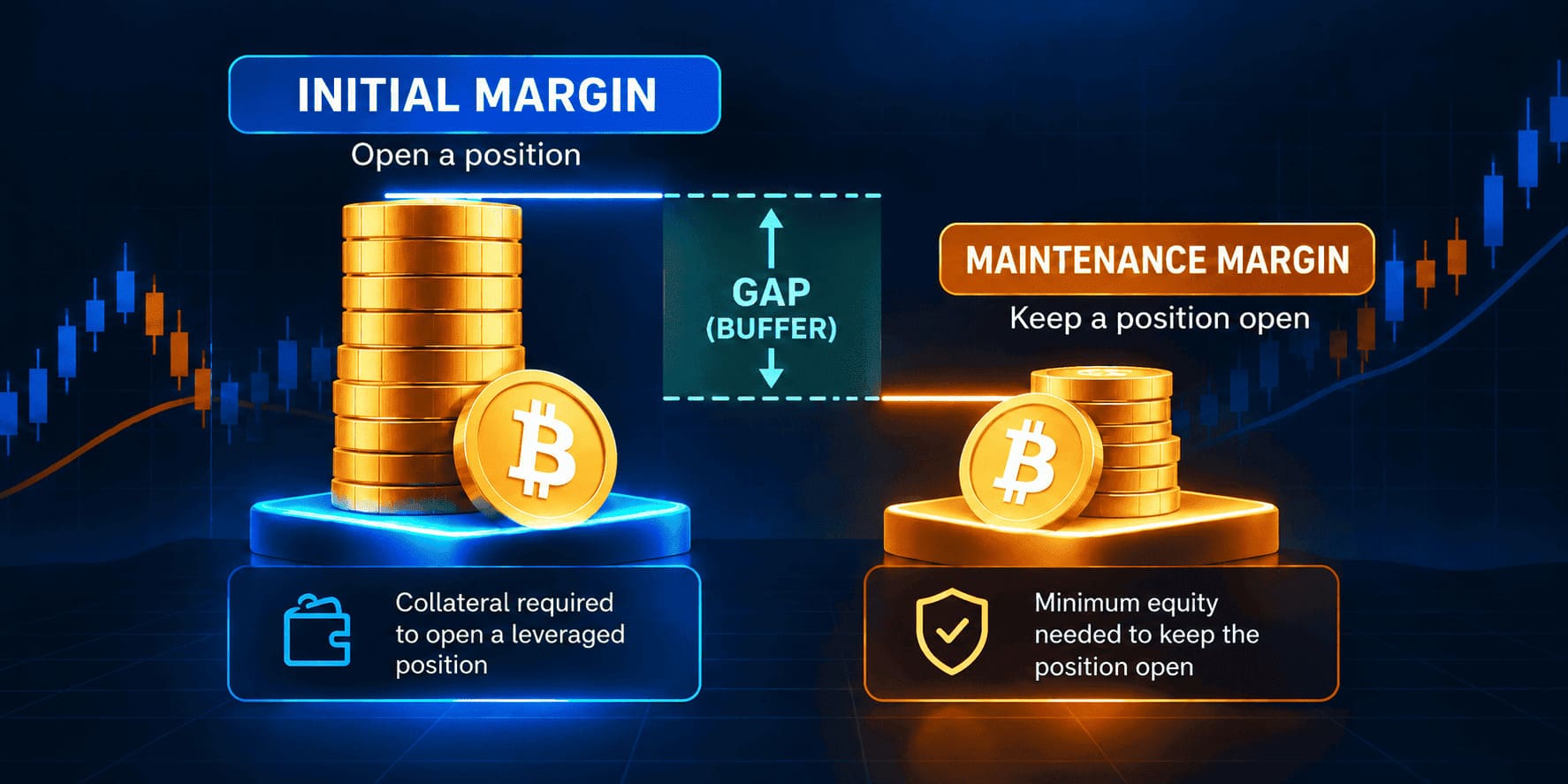 Two Numbers, Two Jobs: Initial Margin vs Maintenance Margin
When a leveraged contract is opened, two types of margin requirement come into consideration. The difference between initial margin vs maintenance margin is how each applies to the position.
For example, when a contract position of 3,000 USDT is opened, the platform calculates the initial margin based on position value and selected leverage.
When the position is open, movement in markets affects the position's unrealized profit or loss. If losses push that equity down to maintenance margin, the position may be liquidated.
The distinction matters: collateral that is enough to open a trade may not be enough to keep it open when price moves against you.
XXKK's Beginner's Guide to Margin Mode explains that the collateral you need also depends on the margin mode you choose.
Initial Margin: The Cost of Entry
Initial margin enables you to control a large contract value without committing the full notional amount upfront.
For a simple USDT-based margined linear contract:
Initial Margin = Position Notional Value ÷ Leverage
Consider an example for a 3,000 USDT position before any costs or fees to be opened at 10x leverage. The initial margin would be around 300 USDT.
3,000 ÷ 10 = 300 USDT
But when leverage is 5x, the calculation changes in the following way:
3,000 ÷ 5 = 600 USDT
At 5x the same 3,000 USDT position needs 600 USDT of initial margin — twice as much, for an unchanged position.
Initial margin is not the most you can lose — you can be liquidated before it is gone. Movements in the market, payments for funding, costs in trading, any additional collateral, and the margin rules can shape the actual losses.
Maintenance Margin: The Cost of Staying In
The minimum equity required for preserving a leveraged position is known as the maintenance margin.
The formula is simple:
Maintenance Margin = Notional Value of Position × Maintenance Margin Rate
For example, in a position of 3,000 USDT, maintenance margin is determined by the applied margin rates and risk tier of the position.
The exact figure also depends on deductions and adjustments that vary by contract.
If losses pile up, the equity supporting the position starts to fall. As it reaches the maintenance margin, liquidation by the platform may be initiated.
To contain further losses, liquidation can close part of the position or all of the position.
You can be liquidated before the position loses its full initial margin.
Why Maintenance Margin Is Usually Lower
In most contract margin setups, initial margin is usually higher than the maintenance margin to provide some room to absorb unwanted price movements.
Consider this simple example for 3,000 USDT position at 10x leverage:
| Margin Component | Amount |
|---|---|
| Initial margin | 300 USDT |
| Maintenance margin | 118 USDT |
| Difference | 182 USDT |
The 182 USDT difference is the buffer between the two.
This means that 182 USDT could be wiped out before liquidation. Maintenance margin could change with the value of the position and applicable fees or other costs that may affect the availability of equity.
Does Leverage Change Your Margin Requirements?
Yes. Initial margin is reduced with an increase in leverage for a position of the same notional value.
In this 3,000 USDT contract position:
| Leverage | Initial Margin |
|---|---|
| 2x | 1,500 USDT |
| 5x | 600 USDT |
| 10x | 300 USDT |
| 20x | 150 USDT |
Figures in the table are for illustration purposes and exclude any fees or additional requirements.
At 20x, the same 3,000 USDT exposure needs only 150 USDT of initial margin.
Even a small price movement can now eat a large share of the collateral.
In the initial margin vs maintenance margin comparison, maintenance margin depends on the value of the position and the risk levels instead of leverage alone. For an unchanged position, an increase in leverage lowers initial margin but does not lower maintenance margin.
However, this could also reduce the collateral buffer and make the estimated liquidation price closer to the entry price.
Where to Read Both on XXKK
Read the margin figures on the XXKK position panel before you open a contract.
The figures that matter most:
Initial margin: This is the required collateral to open a position.
Maintenance margin: This is the minimum equity for maintaining a position.
Position margin: This is the collateral that is committed to support a position.
Liquidation price: This is the estimated price at which liquidation may be triggered.
Different contracts and position interfaces may display varied figures, including position margin.
Before increasing leverage on XXKK, check your maintenance margin and current liquidation price.
The list of available contracts can be browsed through XXKK Markets, or you can open an account through the XXKK homepage to see both margin figures on your positions.
The order panel may let you commit every unit of collateral — that does not mean you should. Leave a buffer above the maintenance margin instead of sizing the position to the limit. Adverse price movement could be tackled by leaving additional margin, although this could not eliminate the liquidation risk.
Conclusion
In a leveraged contract position, initial margin and maintenance margin serve different purposes.
Awareness of both margins can help with interpreting position risk, especially when leverage or exposure is increasing.
Remember to look at the initial margin, maintenance margin, and estimated liquidation price before opening a contract on XXKK rather than depending on leverage alone.
FAQs
What is the difference between initial and maintenance margin?
Initial margin is the required collateral to open a leveraged position. The minimum equity required to keep it open is maintenance margin. Failing to maintain maintenance margin may trigger liquidation of the position.
How is initial margin calculated?
For a simple linear contract, divide the notional value of the position by its leverage.
How is maintenance margin calculated?
The notional value and the applicable maintenance margin rate are used to calculate the maintenance margin. The eventual amount may include adjustments for risk, applicable deductions, or other contract-specific requirements.
What happens when my balance falls below the maintenance margin?
The liquidation of the position may begin if the supporting equity level falls below the maintenance margin. The position may be closed or reduced as per the liquidation rules of the platform.
