CME Futures Trading Hours: Sessions and Settlement Times
CME Futures Trading Hours: Sessions and Settlement Times
CME futures trading hours set the session, holiday, and settlement schedule for futures. Here is how the CME timetable works and what it changes for you.
Quick Answer
The trading hours for CME futures vary according to the particular contract; a number of them are traded almost continuously on weekdays, whereas others have different trading periods. It is possible to leave a position open after a session has ended, and the way you manage them will be influenced by daily settlement, margin rules, expiration, position limits and trading halts.
Key Takeaways:
-
Find out the reason why CME futures do not have the same trading schedule.
-
The fact that a market is closing for the day does not mean that your position will be closed as well.
-
Know the difference between daily settlement and final settlement and the purposes that are associated with each of them.
-
Position limits serve to restrict the amount of exposure on contracts, while margin requirements deal with the collateral.
-
Know how trading halts can prevent execution and leave orders or positions exposed to changing market conditions.
The crypto markets run continuously, while the traditional financial markets have different schedules, trading rules, and settlement procedures. When you are transitioning from crypto trading to futures trading, understanding these differences can aid you in planning your orders and in managing your open positions.
Futures contracts are available from CME Group for a variety of assets including stock indexes, currencies, commodities, interest rates, and cryptocurrencies. Yet the trading hours for CME futures are not the same for all products, since the trading sessions, the settlement times, the margin requirements, and the position limits vary according to the contract and its rules.
The Rules That Do Not Exist in Crypto
Most of the time, crypto trading platforms are open 24 hours a day, seven days a week, while traditional financial markets have defined sessions, scheduled periods of maintenance, holidays and dates on which contracts expire.
The trading of CME futures takes place electronically through CME Globex, but each product has its own trading schedule; for some cryptocurrency futures trading occurs almost continuously with only brief maintenance intervals, while for other contracts the trading hours are different.
That is to say you should not assume that a certain market will still be there when you want to get into or out of a position.
Session Hours and Why They Matter
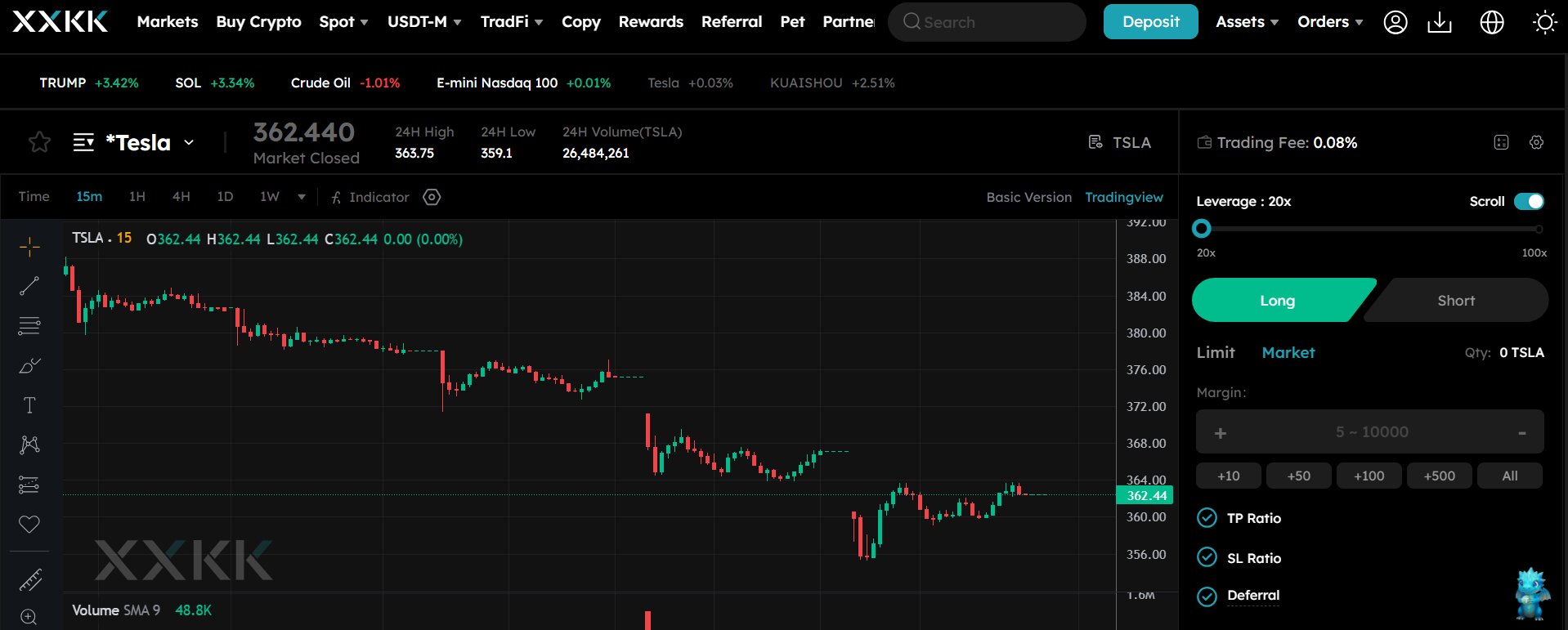 Source: XXKK Tesla TradFi Page
A market session is a period during which a particular contract can be traded. Some futures trade for most of the business week with a daily interruption, while others have more restricted hours.
For instance, many of the CME equity index futures are traded almost continuously for 24 hours on weekdays, with a daily maintenance interval. The usual US stock market session, on the other hand, follows a different timetable.
Make sure that you check the official trading calendar and the contract specifications for the product that you plan to trade, and note the time zone, the daily breaks, the holidays, and the final trading day.
The trading hours in TradFi markets are by no means the same. For example, various financial instruments such as US stocks, futures, foreign exchange, and so on, have individual trading schedules. In addition, contracts traded on the same exchange may also have different hours for trading.
It is important to plan during the market session since a position may still be exposed to changes in price even if you are not able to trade it.
Settlement Cycles in Plain Terms
Settlement refers to the way in which a trading or contractual obligation is fulfilled. In the case of futures markets, it is necessary to make the distinction between daily settlement and final settlement.
Daily settlement is the method by which the official daily settlement price of a contract is determined and the gains or losses are calculated for the purpose of margin. Depending on the broker and clearing arrangements you have, your account could end up receiving money or be required to pay money as the value of an open position changes.
The final settlement takes place when a futures contract that is about to expire is carried out in accordance with its terms; in some cases the settlement is made by means of cash while in other instances it involves actual delivery. Many retail traders close their positions prior to the contract's expiry in order to avoid taking on obligations which they have no intention of fulfilling.
What happens to your position when the market closes? Your position might remain open after the session ends.
What is settlement and does it affect you? Settlement determines your profits, losses and how contract obligations are handled.
Position Limits, Margin Requirements, and Risk Controls
Position limits are rules which specify the greatest number of contracts that a market participant is allowed to hold in certain situations. The limits that apply will depend on the product and may be different for spot-month, single-month, and all-month positions. Exemptions might, however, be granted in accordance with the exchange rules.
The margin requirements vary. Margin refers to the collateral that is needed to hold a futures position. In a situation where your account falls below the required level, your broker might request that you deposit more funds or decrease your exposure. It is possible for positions to be closed out depending on the agreement and the circumstances.
It is wrong to regard margin as equivalent to the greatest amount you can trade. Different objectives are served by position limits, margin rules, broker limits, and exchange risk controls.
Before you enter a trade, make sure that you have read the contract specifications and your broker's requirements. Additionally, you should look over the XXKK rules concerning prohibited activities for contracts in order to know what the platform's restrictions are.
What Happens to Your Order During a Halt?
A trading halt temporarily ceases trading in a contract or in the related market and it can happen due to a circuit breaker, a price-limit condition, a technical problem or a regulatory action.
Orders are generally not executed if matching is suspended. Whether or not you can place, modify or cancel an order will depend on the market conditions and the exchange's rules.
When trading starts up again, prices could have changed, liquidity might be different, and an order might be filled at a price which was not expected. The fact is that stopping an operation does not automatically get rid of the risk connected with an open position.
CME's price limits and circuit breakers vary by product. Check the applicable rules instead of assuming every contract follows the same halt procedure.
What Changes for a Crypto-Native Trader
Moving from crypto to futures requires a few practical adjustments:
-
Check the schedule to see the times when the market opens, when it closes, and when it has its maintenance breaks.
-
It is necessary to understand the expiry date since futures contracts have definite dates on which they expire and also have certain rules about settlement.
-
The amount of money you are able to access could be affected by the daily settlement and any changes in margin requirements.
-
The settings for ordering depend on the contract and the broker as to how long the order stays valid and how it is handled when breaks or halts occur.
-
It's important to be aware of the limits: position limits and exchange controls might prevent you from trading certain amounts or may stop trading at certain prices.
The rules form part of the market structure and are not merely things to examine when a problem has arisen.
Conclusion
The trading hours, settlement processes and risk controls for CME futures vary according to the particular contract. Far from the idea that crypto markets are accessible 24 hours a day, futures traders have to take into account the sessions, the maintenance breaks, the expiry dates and any possible halts.
Before you start trading, make sure to read the contract rules and check the schedule using the appropriate time zone. You can see which markets are available through XXKK Markets and open an XXKK account to start trading. It is important to construct your trading plan around the established market hours rather than acting when a session is about to close.
FAQs
What are the trading hours for TradFi markets?
The trading hours depend on the market and the instrument in question; in the case of US stocks there are fixed trading sessions, whereas a number of futures contracts are traded for extended periods during the business week. Certain CME cryptocurrency futures provide almost continuous trading, although this is subject to scheduled maintenance. It is always necessary to check the particular contract calendar.
What happens to my position when the market closes?
You cannot be certain that your position will be closed when a session ends; it may stay open during the break and therefore leave you vulnerable to price changes when trading resumes. It is important that you check your margin requirements, contract rules, and the broker's policies.
What is settlement and does it affect me?
Settlement refers to the process of fulfilling the financial responsibilities of a trade. On a daily basis, futures settlement is used to determine gains and losses, and the final settlement fulfills an expiring contract by means of a cash payment or physical delivery, as determined by the contract's terms. Both types of settlement can have an impact on your account and on your obligations.
What are position limits?
Position limits are the number of contracts that a trader is allowed to hold under the exchange rules which are specified. The limit varies according to the product and the relevant position category. These limits are different from margin requirements and from trading limits set by the broker.
