Crypto Price: How It Is Set and Why It Moves
A crypto price is the last trade on one venue, not a universal fact. Learn how prices form, why exchanges differ and what moves them fastest.
Quick Answer
A crypto price is determined by buying and selling activity on a trading platform. It changes as orders meet, market demand shifts and traders react to new information. The price displayed on one exchange might differ from another because each platform has its own order book, liquidity and trading activity.
A crypto price is the most recent price at which a buyer and seller completed a trade on a specific trading venue. It reflects an actual transaction, not a universal market value. It is also not a guarantee of the price you will receive when placing your own order.
Major Takeaways
The last traded price records the most recent completed transaction on a specific exchange.
Order books show available bids and asks, while the spread measures the gap between them.
Discover how low liquidity and thin order books make prices more sensitive to large orders.
Understand how arbitrage helps reduce price differences between exchanges, although differences often remain.
The Last Trade Is Not the Price
The number that appears next to a crypto on an exchange is generally going to be its last traded price. That's the price at which the last trade on that exchange took place. However, that figure does not in any way represent the price you'll be able to get right now.
For instance, if the last trade in a crypto was at $2,000. Since then you could have had buyers placing bids at $1,995 and sellers placing offers at $2,005. The last price on the screen would still be $2,000 but a new market order could have executed at a different price. Some platforms also display other price references:
Last traded price: The price at which the most recent trade was completed.
Bid price: The highest price a buyer is currently offering.
Ask price: The lowest price a seller is currently asking.
Mark price: A reference price used by derivatives platforms to work out unrealized PnL or liquidation levels.
Index price: A reference price derived from prices across a range of markets.
These figures have different uses. Always be clear as to which price you're looking at before you make a trade.
Order Books, Bids and Spreads
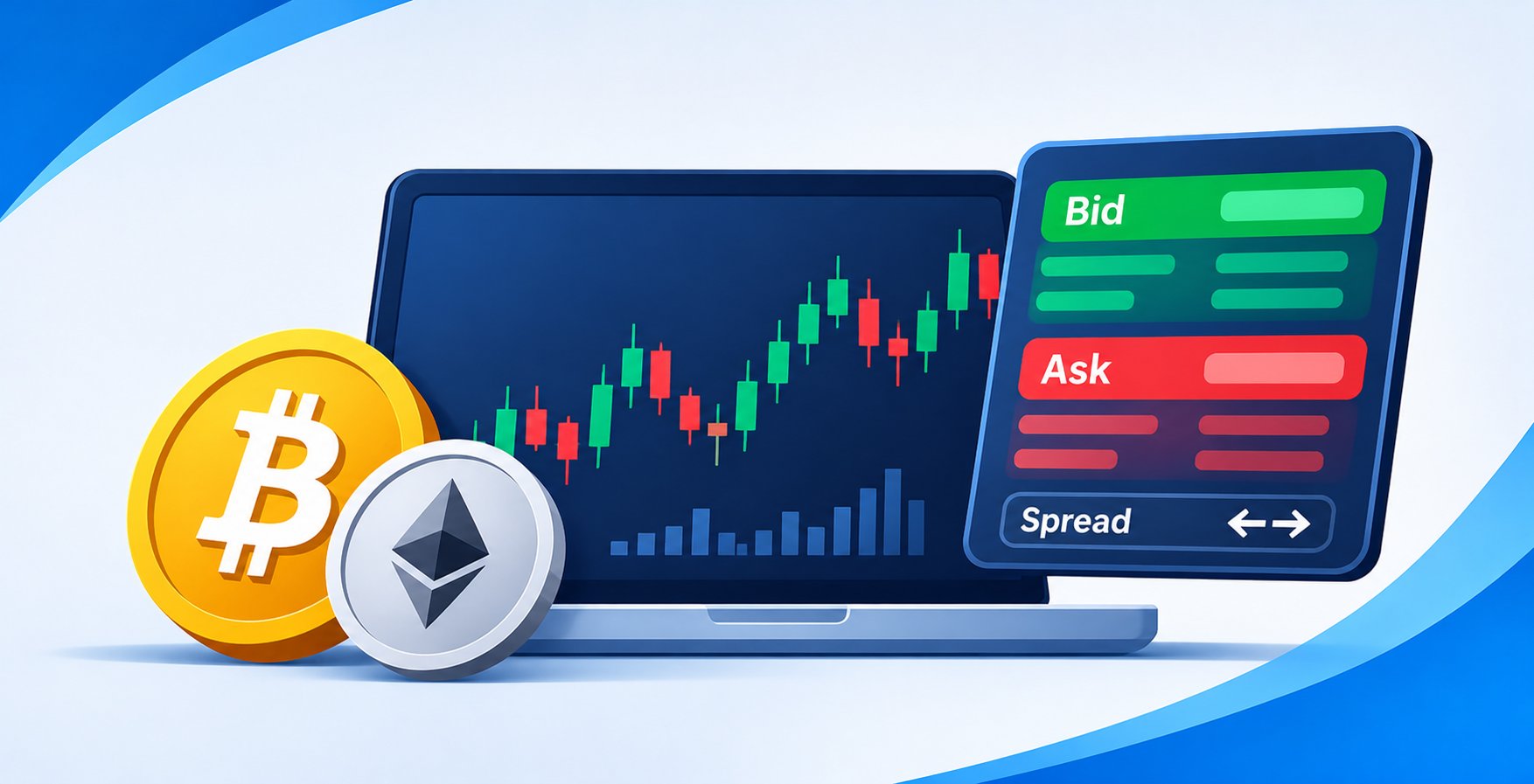 Caption: How crypto prices are determined by market activity, order books and liquidity.
Alt-text: Cryptocurrency trading chart showing Bitcoin, Ethereum, bid and ask orders and the spread.
An order book is simply a list of the open buy and sell orders on an exchange. It's a useful tool for traders to get a sense of what the market is like in terms of price and size. The two main sides are:
Bids: Orders from buyers indicating how much they are prepared to pay.
Asks: Orders from sellers showing what they want to receive.
The best bid and the best ask constitute the best available bid and offer. The spread is the difference between the two prices.
For example:
Highest bid: $1,990
Lowest ask: $2,000
Spread: $10
A narrow spread generally reflects a close agreement between buyers and sellers. A wider spread tends to indicate lower liquidity, greater uncertainty or weaker trading. The order book also shows market depth. Depth is the amount of buy and sell orders available at various price levels.
A deep market will generally be able to absorb larger orders with relatively little price impact. A thin market on the other hand could see quite sharp moves if a relatively small order is enough to consume several of the available price levels.
Why Venues Diverge
Different exchanges will often show different prices for the same crypto as they are running separate markets. Each exchange has its own buyers, its own sellers, its own order book, its own trading volume and its own liquidity. A big buy order on one exchange could push the price up on that exchange, while another exchange might see absolutely nothing happen. Other factors include:
Different levels of trading activity.
Variations in market depth.
Differences in trading fees.
Deposit and withdrawal restrictions.
Regional demand and currency conversion costs.
Delays in price or market data updates.
For example Bitcoin might be trading at $90,000 on one exchange and $90,050 on another. That doesn't necessarily mean there's an error. That's just the nature of the two markets being different. Arbitrage helps to eliminate such price disparities. You buy the asset where it's cheap and sell it where it's expensive. That activity will tend to bring the prices together. Arbitrage is not instant and is not guaranteed. Trading fees, withdrawal delays, network costs and price movements could all wipe the arbitrage out entirely.
What Moves Price Fastest
Crypto prices are a function of supply and demand and market expectations. Some events lead to a gradual shift in price; others cause a sharp move in either direction. Common price drivers include:
Large market orders: A large buy order will eat up all the available sell orders and can in fact push the price up. A large sell order has the opposite effect.
Breaking news: Regulatory announcements, security incidents, exchange developments or major partnerships could all have an impact on market expectations.
Economic data (interest rates, inflation numbers, currency movements etc.) will obviously have a bearing on how traders view risk.
Liquidations: Forced position closures in leveraged markets create further buying or selling pressure.
Liquidity has changed: The market depth is lower so prices are more sensitive to the incoming orders.
Big transfers and trading activity: Big moves between wallets and exchanges could have an impact on market sentiment, though moves between wallets in themselves don't necessarily indicate a buy or a sell.
The order book is very important during periods of high volatility. If the available orders are vanishing quickly then even fairly modest levels of market activity can result in a significant price move.
Reading Volume With Price
Trading volume is a measure of how much of an asset is traded over a given period of time. It's a way of measuring the level of activity behind a price move. Consider these examples:
Rising price with increasing volume: The price is higher as volume increases, though of course that doesn't guarantee the trend will continue.
Rising price with declining volume: The move is happening with less volume.
Falling price with increasing volume: There's very strong selling activity going on as the price is falling.
Falling price with declining volume: Selling activity has been down over the period.
Volume is all about context. Some exchanges will report different volumes simply because they have different customer bases, different trading pairs and different ways of reporting.
You should also be careful to separate reported volume from actual market liquidity. High volume doesn't necessarily equate to high liquidity.
Which Number to Trust
The best price is the one that's appropriate for what you are trying to achieve. If you want to know what the last transaction was, look at the last traded price. If you are planning to buy then you'll want to look at the lowest ask. If you are planning to sell then you'll want to look at the highest bid. Before placing an order, review:
The exchange and the trading pair.
The latest traded price.
The best bid and ask.
The spread between them.
Order book depth at your intended order size.
Recent trading volume.
Whether the figure shown is a last price, a mark price or an index price.
Thin books make the ticker a very poor guide as to what the price will be if you are going to do a large trade. The quote you see displayed may well change the moment your order gets into the market. Read the order book and not just the ticker.
For a practical introduction to buying and selling digital assets, read Spot Trading Basics. You can also explore broader market developments in the Crypto Market Outlook 2026.
Visit XXKK Markets to explore available trading markets or go to XXKK Home to create an account.
Conclusion
A crypto price reflects trading activity on a particular exchange. The last traded price records the latest completed transaction, while bids, asks, spreads and order book depth show the conditions for future trades.
Understanding liquidity, volume and arbitrage helps explain why prices move and why exchanges sometimes show different figures. Before placing an order, compare prices and examine the available market depth.
FAQs
How is a crypto price set?
A crypto price is set through buying and selling activity on an exchange. When a buyer's bid matches a seller's ask, a trade occurs at an agreed price. The exchange records this transaction as the latest traded price. New orders and changes in demand then influence subsequent trades.
Why do exchanges show different prices?
Exchanges show different prices because each operates a separate market with its own buyers, sellers, order book and liquidity. Trading volume, market depth, fees and regional demand also contribute to price differences. Arbitrage helps narrow these gaps, but transaction costs and transfer delays often prevent prices from matching exactly.
What is the spread?
Spread is the difference between the highest price a buyer offers and the lowest price a seller requests. For example, a $99 highest bid and a $100 lowest ask produce a $1 spread. A narrow spread often indicates stronger liquidity, while a wide spread might signal limited trading activity.
What moves price fastest?
Large market orders, breaking news, liquidations and sudden changes in liquidity often move crypto prices quickly. A large order might consume several levels of an order book, pushing the price away from its previous level. During volatile periods, reduced market depth often increases the impact of incoming trades.
What makes silver different from gold?
Silver differs from gold in its industrial uses, market demand, price behavior and supply dynamics. Silver plays a major role in electronics, solar panels and other manufacturing processes, while gold is used mainly for jewelry, investment and reserves. Silver prices often respond more strongly to changes in industrial demand.
