Risk Reserve Fund: How Exchanges Cover a Shortfall
Risk Reserve Fund: How Exchanges Cover a Shortfall
A risk reserve fund is the buffer an exchange uses when a position cannot be closed at its liquidation price. Here is what it covers, and what it does not.
 Quick Answer
A risk reserve fund is a pool of money a crypto exchange sets aside to absorb losses when a liquidated contract position closes at a worse price than its bankruptcy price. See it as the fund you keep in a separate bank account to cover unpredictable expenses. The risk reserve fund keeps the winning side of a trade whole. It does not refund your margin or your trading losses.
As a crypto derivatives trader, you may have seen the term “risk reserve fund” on a fee schedule or contract page and wondered whether it protects your money or just pays for someone else’s bad trade. This guide explains how the risk reserve fund crypto exchanges use on the derivatives market works, and where its protection ends.
Major Takeaways
The fund covers the deficit left when a liquidation closes beyond the point where the trader’s margin reaches zero.
It is usually derived from liquidation surpluses over time.
It does not cover your own margin (capital) or normal trading losses.
If the fund runs dry, auto-deleveraging (ADL) starts, reducing profitable positions.
What a Risk Reserve Fund Is For
One of traders’ most common concerns in any market is the safety of their investments amid unforeseen circumstances, and in leveraged crypto trading, that worry is justified. An exchange risk reserve isn’t an account, but a buffer for the platform itself.
For instance, say you open a leveraged long position on Bitcoin, and the price plunges past your liquidation price before the exchange can close the position. You’ll lose only your margin, not more, because the risk reserve fund absorbs the extra loss.
Every crypto exchange runs its own version; the fund's size, funding rules, and coverage terms differ and change over time.
This article describes, in general, how this kind of fund works. Meanwhile, the actual terms for XXKK exchange are in its contract specifications.
Where the Money Comes From
An exchange risk reserve is built from several sources, which include:
liquidation surplus
liquidation fees
the exchange’s own capital
a share of general trading fee revenue, depending on the exchange
How It Works With Liquidation and Bankruptcy PriceHow It Works With Liquidation and Bankruptcy Price
 Liquidation happens when an exchange closes a trade after the trader takes heavy losses, depending on the margin size and leverage used. The price at which this happens is the liquidation price.
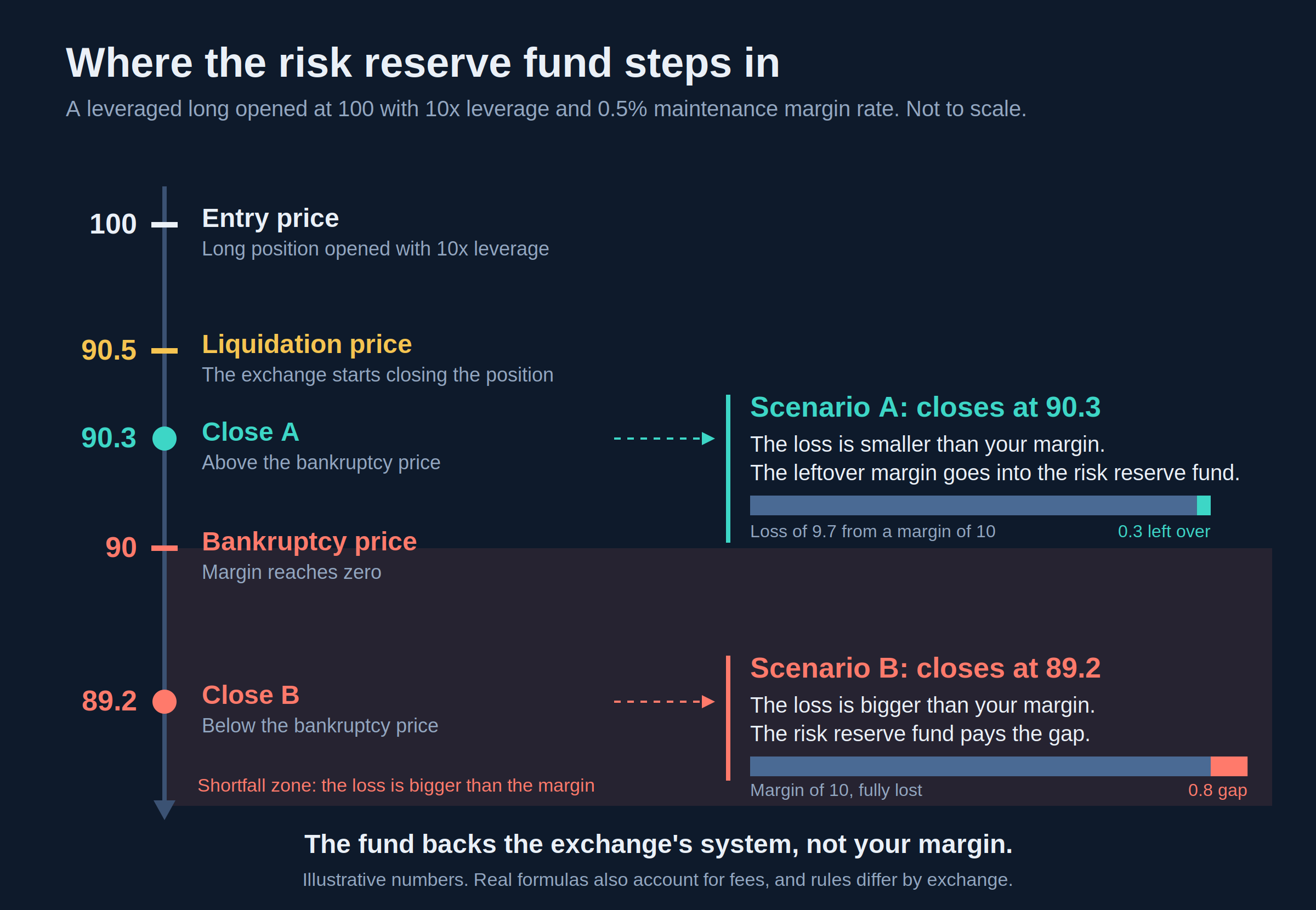
The bankruptcy price sits a little further out from the liquidation price; It is the point at which the trader’s margin is completely used up. Most crypto exchanges liquidate positions a little early to prevent them from reaching that point.
Here is an example:
You opened a SOLUSDT long position at 100 with 10x leverage. Your margin is 10% of the position, so the bankruptcy price is 90. Liquidation triggers near 90.5, with a 0.5% maintenance margin rate. (Note: These numbers are for illustration, and real formulas also account for fees.)
If the crypto exchange liquidation mechanism closes the position at 90.3, your loss is smaller than your margin. The remaining margin goes to the risk reserve fund.
On the other hand, if the exchange liquidates the position at 89.2, the market gaps through. The loss exceeds your margin, and the risk reserve fund covers the gap.
In both cases, the person holding the opposite position receives what they are owed.
What the Fund Does Not Cover
The reserve fund will never cover regular trading losses.
If you short Bitcoin with leverage and the price surges, your position may be liquidated at the liquidation price. The fund will not reimburse your lost capital.
It also does not cover lost profits, missed opportunities, or fees. An exchange risk reserve only protects the system so that winning traders get paid.
What Happens If the Fund Runs Out: Auto-Deleveraging
If a shortfall exceeds the exchange’s available funds, many exchanges use auto-deleveraging (ADL). This mechanism reduces highly profitable positions to cover losses from bankrupt liquidations and avoid debt.
ADL is a last-resort measure some crypto exchanges use when they can't settle trade losses at the time.
Where to Read the Terms for Your Exchange
You can find your crypto exchange’s terms in its contract specifications.
Check how liquidation works, how the fund is described, and what the exchange says happens when the fund is depleted.
If you trade perpetuals, the XXKK guide to perpetual contracts explains how they differ from spot trading, and you should review the contract specifications on XXKK Markets before you assume a loss is covered.
Conclusion
The fund exists, so a price gap doesn’t leave winning traders unpaid. It does not make your account whole.
Open an XXKK account to review for yourself the contract specifications that apply to you, and read them before you assume a loss is covered. Manage your margin and leverage first, as the risk reserve fund is not a substitute.
FAQs
What is a risk reserve fund?
It is a pool of money that crypto exchanges set aside to cover losses when a liquidated position closes beyond its bankruptcy price. The risk reserve fund crypto traders see in contract specifications is a derivatives market feature that acts as a financial buffer and is also called an “insurance fund.”
How does a risk reserve fund work?
When the exchange liquidates a position, any remaining margin goes into the fund. If a position closes at a worse price than its bankruptcy price, the fund pays the shortfall. If the fund cannot cover it, the exchange may use auto-deleveraging.
Does the risk reserve fund protect my account balance?
No, it doesn’t protect your margin, replace what you lose, or offset trading losses. It covers the gap below zero on a liquidated trade so the other side gets paid.
Where does the money in the risk reserve fund come from?
Most often, from liquidation surplus. Some exchanges also add a share of liquidation fees or contribute their own funds. The specific terms vary by exchange.
