Crypto ETF: How Spot Funds Work and What They Change
A crypto ETF gives share-market access to a coin without a wallet. Learn how spot funds are structured, what they cost, and what they do not fix.
 Quick Answer
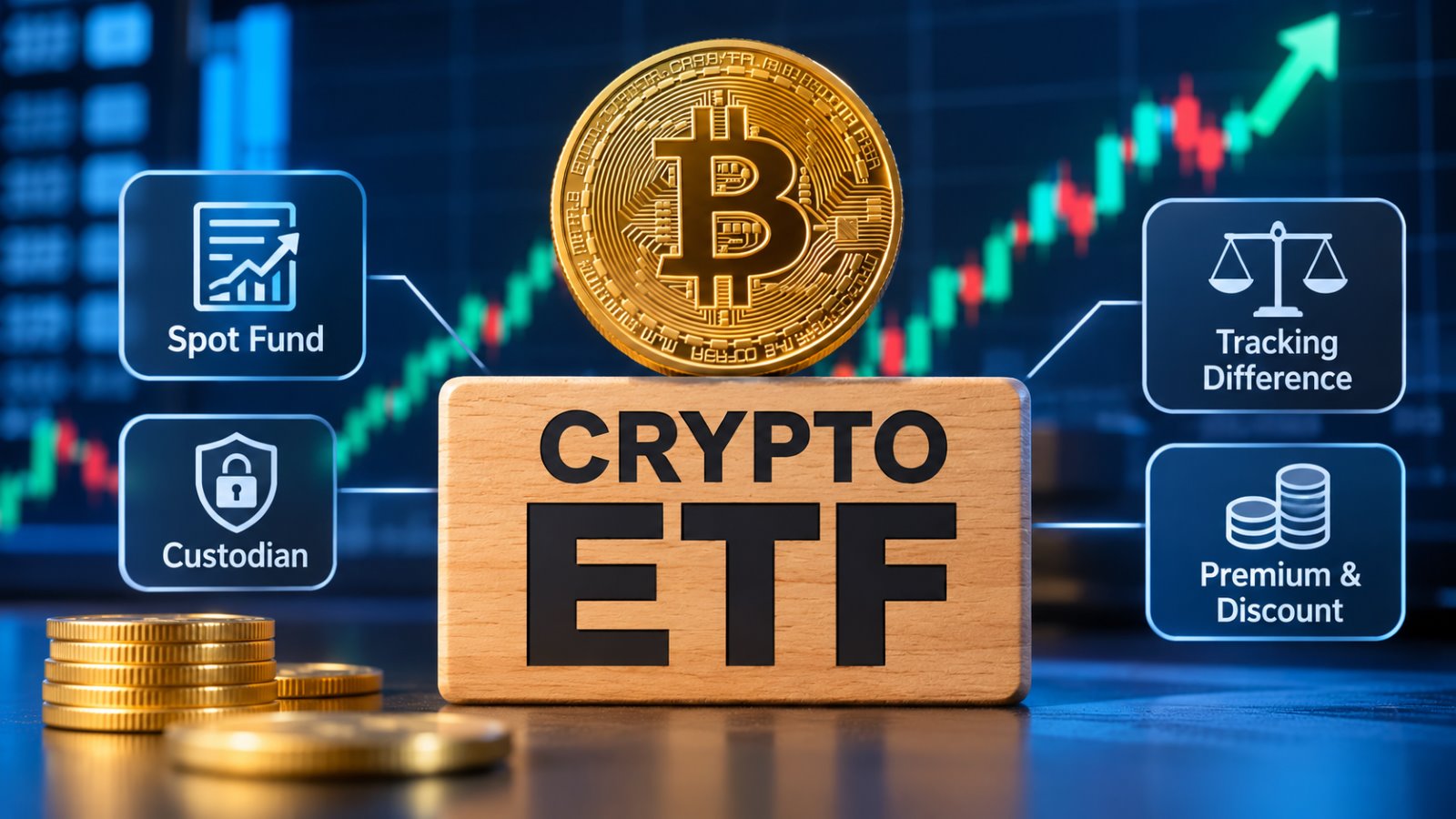
A crypto ETF is an exchange-traded wrapper that provides price exposure to the coin via a brokerage account, while a spot crypto ETF is one that holds the coin with a custodian. The wrapper changes how you get exposure and who maintains control of the keys. The wrapper doesn't take the price volatility or custody risk of the fund away.
The spot ETF is a listed product, with the coin's price tracked by the ETF's own shares while a custodian holds the coin. Futures-based products and notes follow other formulations. But all of them are covered in the search by simply using the crypto ETF term, so the legal wrapper does matter.
Major Takeaways
A spot fund's coin is held by a custodian that controls the private keys
Authorized participants can create and redeem shares, which may help keep the share price close to NAV.
Spot crypto ETPs tracked net asset value less well than similar ETFs, according to a Federal Reserve paper.
Fund shares are traded during exchange hours, with the coin's market open all day.
What a Crypto ETF Actually Holds
The best crypto ETF isn't one legal structure. When searching for a crypto ETF, one may be referring to a number of them. Spot funds own the coin, futures-based funds own contracts on the coin, and in the UK the retail route has gone through notes rather than funds.
The existence of a spot fund is pretty straightforward: It holds the coin, perhaps in a vault. The custodian possesses the private keys. Regulators require funds to report where they hold the keys, whether they allow customer assets to be mixed, and whether the fund's insureds are dedicated or shared. In the US, the SEC investor bulletin on spot bitcoin and ether products refers to them as exchange-traded commodity trusts and not registered investment companies. Canada and Australia prefer fund structures.
As a shareholder of a trust or fund, you own a security that was issued by a fund or fund company. You don't own the coin itself or the keys to your coin. How a fund chooses to stake its fund's holdings and how it handles forks and airdrops are all left to the fund's documents.
There is an alternative approach too - futures-based funds. Instead of the coin, these funds don't own the original asset but the futures - and thus their performance will be based on the futures curve in addition to the rollover of the contracts and the coin's value. Futures prices may vary from the spot, and with a futures contract, no coin is owned. This is why the value of the futures-based fund and a spot fund can vary.
Creation, Redemption and the Share Price
Almost all shareholders buy and sell on an exchange, but don't actually create or redeem shares. Creation and redemption happen between the fund and authorized participants, big banks and brokerages with special arrangements to buy and sell directly with the fund. When a participant creates, it delivers a basket - or cash equivalent - and gets new shares. Redemption is the reverse. Market makers do both: They quote prices and make the exchange process liquid.
The fund has the ability to settle trades in cash or in kind. When settling in cash, one person has exchanged cash for coin and vice versa. When settling in kind, the coin itself travels between the participant and the fund.
Net asset value (NAV): Total assets minus total liabilities of the fund, divided by the number of shares outstanding. For spot funds, disclosures tell you which benchmark price was used to value the coin. Arbitrage can anchor the share price to NAV.
When shares are trading above NAV, investors can create and sell shares; when below the NAV, they can buy and redeem them. That can narrow the spread. It does not guarantee it.
Costs and Tracking Difference
Costs come in categories, and no figures belong in a structural guide. A fund can charge a sponsor or management fee, plus custody, administration, and other operating expenses. In a US trust that earns no income, the sponsor fee typically covers operating expenses, and each payment lowers the amount of the coin each share represents. You pay brokerage commissions and the bid-ask spread separately when you trade. A fund-level charge isn't the full cost of holding a product.
Where to look depends on the country. A US trust's prospectus and registration statement carry the sponsor charge, operating expenses, and benchmark method. Canada's ETF Facts is a short summary, with the prospectus holding more detail. In Australia, the product disclosure statement and periodic statements cover fees and costs. A UK note's prospectus and final terms set out its charges and repayment terms.
The tracking difference is the difference in return (it could be positive or negative) between the fund's return and its benchmark return for a specified period. Tracking error is a measure of how much those differences vary over time. Two funds can have similar tracking difference and very different tracking error. Providers don't necessarily publish these figures in the same way, so compare the same benchmark and the same period before jumping to any conclusions.
Premium and Discount
When a fund's market price exceeds its NAV, the fund is trading at a premium. When the fund's market price is less than its NAV, the fund is trading at a discount. It's worth comparing the share price with the NAV, rather than with the most recent quote on the crypto platform, so the fund's shares can be at a premium or a discount to both.
This Federal Reserve note, published March 28, 2025, looks at the five biggest spot crypto ETPs that started trading in 2024. They had comparable bid-ask spreads as the rest of their size class, but they tracked NAV less well. The authors attribute that in part to arbitrage opportunities between crypto and equity markets and call in-kind redemptions "a promising avenue" to narrow the premiums. The paper studies an earlier era, and it is not a prediction.
Different regulators tackle the identical hole from the market facet. Australia's ASIC requires market operators to verify whether or not the ETP's value stays roughly in keeping with NAV and if market-maker arrangements are working. When the coin is traded outside of native hours, an indicative NAV may want adjusting or should not be printed in any respect.
What It Does Not Solve
An ETF wrapper does not eliminate the coin's volatility. Regulators note that spot products can experience sudden large swings, and that a share price may deviate from the coin's price. An ETF wrapper also does not eliminate the risk of holding the coin. That risk is shifted onto the custodian and fund's operational arrangements; hence, disclosures around principal storage and insurance are critical.
You're not in the driving seat over the coin. A typical brokerage share won't allow you to transfer, spend, or cast a vote with the coin, nor does any staking or Fork management happen through the fund's documents. Trading hours are different. Fund shares can be bought or sold when the exchange is open, but crypto markets never shut. Buying the coin directly varies, and the crypto spot trading guide shows you how. Futures funds introduce an additional factor: they maintain an expiration date for contracts, and others are substituted during that time.
Regulatory status differs by country as well. The UK's retail route covers qualifying notes, which are debt securities and not funds. Tax treatment varies by product and place, so it needs a check against current local guidance. A fund's legal wrapper decides which rules apply to it.
Who It Fits and Who It Does Not
Regulators do not specify a certain kind of investor that a crypto ETF is for. Instead, they highlight these factors that investors should consider: the legal structure, volatility of the underlying coin, custody of assets, reference benchmark, disclosures, liquidity and trading of the shares. Canadian staff guidance further states firms have know-your-product and suitability obligations when marketing and distributing these funds.
Read that as a list of product capabilities, not as a value judgment of any sort. A fund belongs in a brokerage account structure and an investment wrapper. It does not belong to anyone who needs on-chain use or 24/7 trading. Whether that trade-off matters to you is a personal question, and a licensed professional can help you decide.
Conclusion
A crypto ETF swaps wallet management for a custodian, a legal wrapper, and exchange hours. What sits behind the ticker decides what you actually own.
Create an XXKK account to explore crypto markets.
Read the fact sheet, not the marketing page.
Compare tracking, not just fees.
Compare the wrapper with the coin it tracks.
FAQs
What is a crypto ETF?
A crypto ETF is a broad search term for an exchange-traded product that gives exposure to a coin's price. Some hold the coin, and some hold futures contracts. Notes are a separate debt-security structure. The label alone doesn't show what a product holds.
How does a spot fund hold the coin?
A spot fund keeps the coin with a custodian, which controls the private keys under documented storage and access procedures. Regulators expect disclosure of how keys are stored, whether assets are commingled, and whether insurance is dedicated or shared. Holding through a custodian shifts custody risk to that provider. It doesn't eliminate it.
What does it cost?
Costs fall into categories: a sponsor or management fee, custody and other operating expenses, plus brokerage commissions and the bid-ask spread when you trade. There's no single best crypto ETF by cost alone, because tracking difference and premium or discount also matter.
How does it track the price?
A spot fund values its coin using a benchmark or reference price, and NAV reflects its assets minus liabilities per share. Creation, redemption, and market makers can help keep the share price near NAV. Tracking difference measures the return gap against the benchmark, and premiums or discounts can still appear.
What does it not solve?
It doesn't remove the coin's price volatility, and it doesn't give you control of private keys. Custody risk moves to the fund's custodian rather than disappearing. Shares also trade only during exchange hours, while the coin's market keeps running, so the share price can lag moves that happen overnight.
