Quad Witching: Why Volume Spikes Four Times a Year
Quad Witching: Why Volume Spikes Four Times a Year
Quad witching is when four US futures and options contracts expire together. See why volume spikes and what it means for your orders.
Quick Answer
Quad witching is the quarterly derivatives expiration event that is traditionally associated with the third Friday of March, June, September and December. Closing positions, contract rollovers and hedging adjustments tend to increase trading volume, but the event does not guarantee a particular price movement.
Key Takeaways:
Understand how quad witching is traditionally associated with the four quarterly expiration dates.
Learn why triple witching is the most common term in modern US markets.
Understand when position adjustments and hedging can contribute to a volume spike.
Know why crypto markets can experience related activity and why they have their own derivatives expiration schedules.
Understand why higher volume does not guarantee higher volatility, good liquidity or a precise price direction.
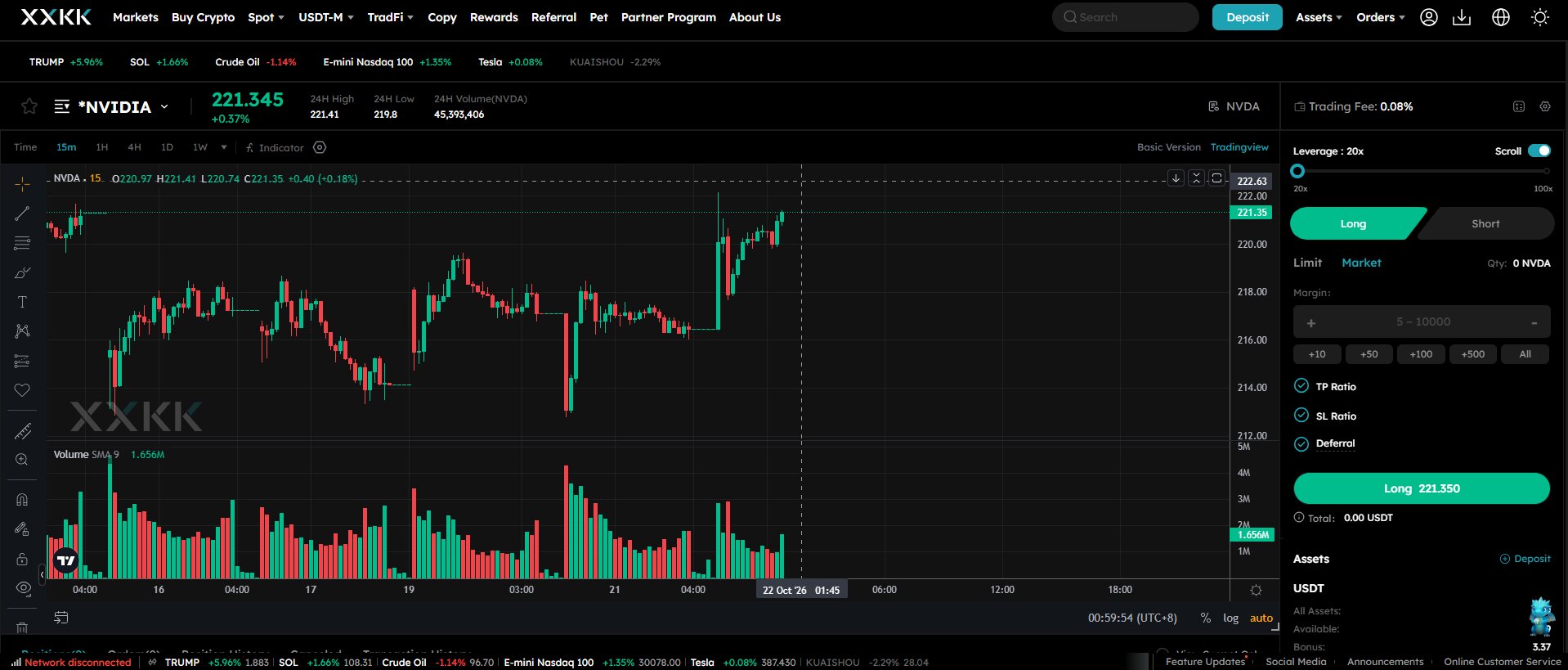 Source: XXKK TradFi Page
You might have noticed odd trading activity at certain dates on the financial calendar and that could be due to quad witching. This phenomenon occurs four times each year, and the expiration of different types of derivatives contracts takes place during the same trading session.
As a trader watching the stock market, index futures, options or crypto markets, understanding quad witching can help explain sudden changes in trading volume, liquidity, and short-term market volatility.
It does not follow that a greater volume will cause prices to go up or down; the outcome varies according to market conditions and the positions that traders have to take.
What Quad Witching Is
Because options expirations take place alongside other derivatives expirations, traders and institutions may adjust their positions across several markets at the same time. Quad witching refers to the simultaneous expiration of four types of financial derivatives:
Stock options
Stock index options
Stock index futures
Single-stock futures
Traders and institutions are able to obtain exposure to assets or hedge their financial risk without having to buy or sell the relevant assets directly.
When contracts near the end of their term, market participants have the option of closing out their positions, transferring them to later contracts, or letting them expire as provided for in the terms. This can in turn lead to higher levels of trading on the expiry date.
You might also come across the term 'triple witching'. This is the name given to the situation when stock options, stock index options, and stock index futures all expire. In the United States nowadays, the term triple witching is more frequently used since single-stock futures are no longer a significant element of the standard US market structure.
The terms are linked, but the important point is that several derivative contracts may expire simultaneously, causing extra activity as traders adjust their positions.
When Quad Witching Happens
According to the US derivatives calendar, quad witching usually occurs on the third Friday in March, June, September and December.
Because several of the important contract expiries occur at the same time, trading interest in these quarterly dates will be higher. Nevertheless, the precise times of expiry and the trading arrangements will vary according to the contract, the exchange, and the relevant calendar.
Not all contracts expire on the same day, and the schedule may be influenced by holidays or by rules that are particular to the product.
If you are trading on those dates, you ought to consult the relevant exchange's expiration calendar rather than relying merely on the general quarterly schedule.
Why Volume Spikes at Expiration
A spike in volume happens when there is more trading activity than normal over a given period, and this increase can be due to several factors during quad witching.
1. Traders close expiring positions
Traders who have options or futures contracts may close their positions before the expiry date in order to manage their risk or in order to avoid keeping the contracts beyond that point.
2. Institutions roll positions forward
Certain traders wish to keep their exposure after an existing contract has expired. In such cases, they can close out the contract that is expiring and at the same time open a similar position in a contract that has a later date. This procedure is referred to as rolling a position.
3. Hedging activity changes
Market makers and institutional traders have the possibility of altering their hedges as options and futures approach expiry. These changes could lead to additional buying or selling of the underlying assets or of the related contracts.
4. Trading activity becomes concentrated
There is a tendency for transactions to be directed towards certain instruments or to take place just before the market closes when a large number of contracts expire on the same day, leading to a considerable rise in trading volume.
One cannot be sure that a higher volume will lead to extreme market volatility, since part of the activity might just be due to positions being transferred from one contract to another rather than traders taking new directional bets.
How Quad Witching Reaches Crypto Markets
The cryptocurrency markets don't mirror the conventional US equity derivatives expiration calendar in exactly the same way, but crypto traders might still observe changes in activity near important TradFi expiration dates.
There are a number of possible explanations.
In the first place, institutional investors take part in both the conventional financial markets and the cryptocurrency markets, and changes in their allocation among different asset classes can affect the way they manage risk.
Second, Bitcoin and the other digital assets have their own option and futures expiration dates; the crypto-specific expirations can have an effect on positioning and hedging independently of quad witching.
Thirdly, general market sentiment and the state of liquidity can at the same time affect both conventional assets and cryptocurrencies.
One should not assume that each surge in crypto trading volume on a quad witching date was due to the expiry of traditional derivatives. Surges could also be caused by the expiry of crypto-specific contracts, economic announcements, liquidations, and other events.
Risk Around Expiry: Volatility and Slippage
Even though a greater trading volume may give more opportunities for orders to be executed, it does not guarantee better liquidity at every price level.
Towards the end of the expiry period, the order books may undergo rapid changes as traders adjust their positions. This might result in short-term price movements, wider spreads for certain instruments, or slippage since an order is filled at a price different from the one expected.
Leveraged traders also face an increased risk of having their positions liquidated if prices change quickly. A position which seems manageable under ordinary circumstances can become more susceptible when prices move sharply.
It is important not to overlook the fact that quad witching does not guarantee a widespread move in prices, since the level of market volatility will differ depending on positioning, liquidity, economic conditions and the particular contracts in question.
Review the XXKK Risk Disclaimer before trading, especially if you use leverage.
Trading Around Quad Witching
Quad witching is something that has to be understood rather than treated as an automatic trading signal. A careful method can help you avoid reacting solely on the basis of volume.
Look at the expiry calendar to find out which contracts are expiring and when their last trading or settlement procedures take place.
Check what volume source is being used: find out if the activity is taking place in the stocks, options, futures or crypto markets.
You should monitor liquidity and spreads since an increase in volume doesn't ensure that your desired order will be executed at the price you anticipate.
When determining the size of your position, think about how much money you might lose if the market moves against you.
Be careful when using stops: it does not guarantee that a stop order will be executed at the specified price under rapidly moving market conditions. Do not set stops so closely that ordinary price fluctuations will cause them to be triggered.
Avoid unsupported predictions: Do not assume that an expiry date means prices must rise, fall, or reverse.
Whether or not you should trade when quad witching will depend on the strategy you are using, your level of experience, and your capacity for taking risks. If you don't understand the contracts in question or the cause of the surge in volume, it might be better to just watch the market rather than enter a trade.
Conclusion
The occurrence known as quad witching is a phenomenon which takes place quarterly in the derivatives market and is associated with increased trading activity in some parts of the US financial markets. It may cause a rise in trading volume as a result of position closures, contract rollovers and hedging adjustments; yet the effect on prices is different.
It is possible that the crypto markets could be connected because of overlapping institutional exposure and the fact that they have respective derivatives markets, although quad witching is not a reliable predictor of changes in crypto prices.
Prior to taking a position, you should check the expiry calendar, look at the liquidity, and allow for slippage. If you want to explore the markets, you can do so on XXKK or open an XXKK account in order to follow the crypto and traditional market instruments available on the platform.
FAQs
What is quad witching?
Quad witching is the phenomenon in which stock options, stock index options, stock index futures, and single-stock futures all expire at the same time, and it is linked to higher levels of trading as market participants modify their expiring positions.
When does quad witching happen?
It is usually connected with the third Friday in March, June, September, and December; the precise expiration schedules will vary according to the contract and the exchange rules.
Why does volume spike on quad witching?
Trading activity can cause volume to rise since traders close out positions that are expiring, roll their contracts forward, and make changes to their hedges. This increased activity doesn't always point to a clear bullish or bearish market trend.
How does quad witching affect crypto markets?
The occurrence of quad witching may be linked to changes in crypto market activity due to the overlap in institutional exposure and the wider market conditions. Yet crypto has its own derivative expirations, and a surge in trading volume on that date does not mean quad witching was the cause.
