Margin Ratio: The Number That Decides Liquidation
Margin Ratio: The Number That Decides Liquidation
The margin ratio shows how much room is left before liquidation. Learn the formula, why a higher number is riskier, and what moves it.
 Quick Answer
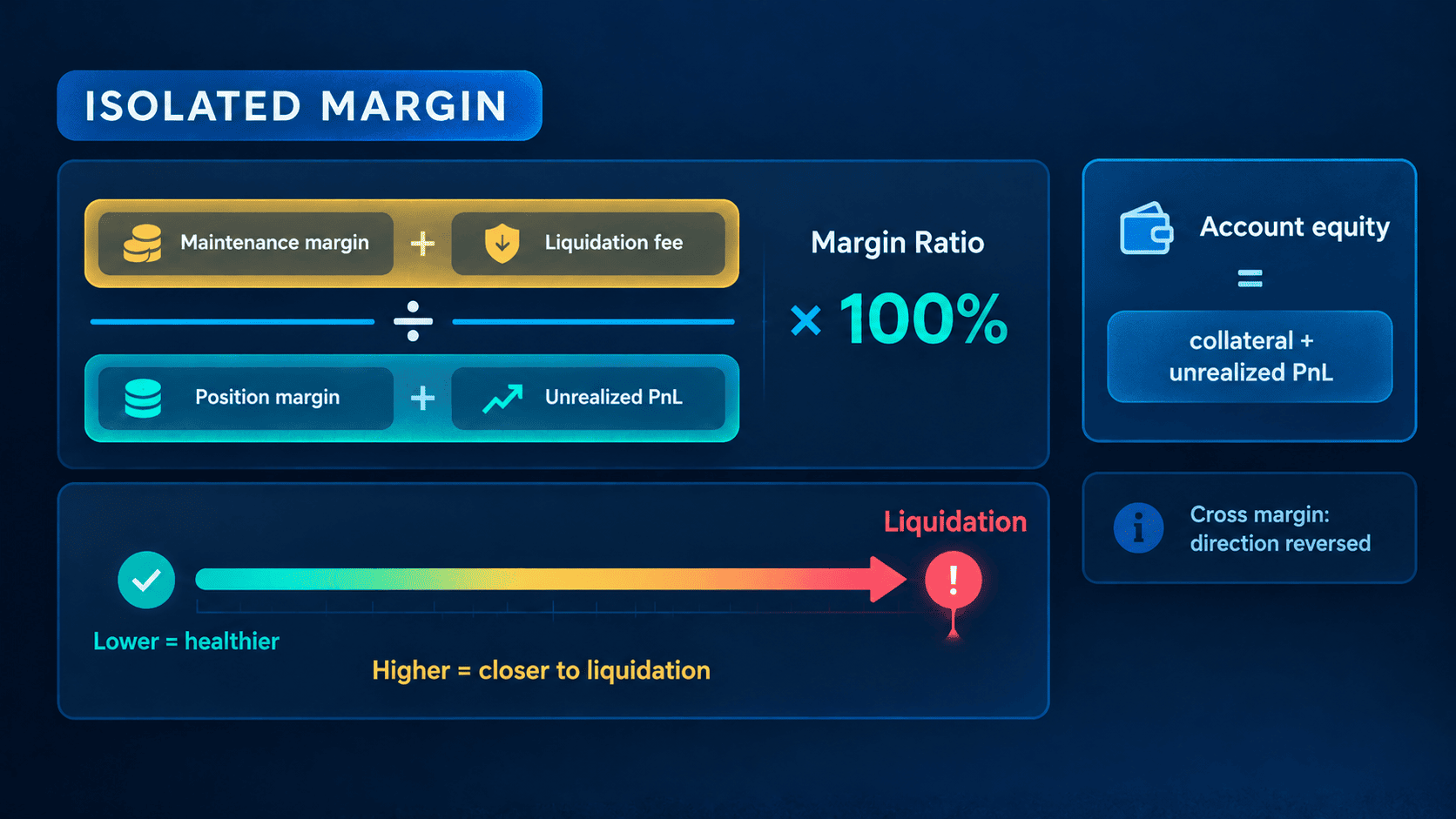
The margin ratio is how close an isolated margin position is to liquidation; the bigger the number, the closer liquidation is. It rises as losses and maintenance margin get higher, while reducing if you add margin or reduce the size of your position.
Major Takeaways
The formula for calculating the isolated margin ratio for XXKK is: (maintenance margin + liquidation fee) / (position margin + unrealized PnL) x 100%.
The ratio gets larger as the position gets closer to liquidation, and XXKK’s margin documentation sets the exact liquidation conditions.
Price changes, funding payments, and leverage all change the ratio by changing the numbers inside that formula.
When it gets higher, you add margin or reduce the size of your position to bring it lower.
Margin Trading: What the Ratio Measures
Margin trading means you put up a margin deposit that allows you to take a larger position than the cash you put up for it. The exchange backs you up, and that margin is supposed to keep up with the position as the price moves. When people type in "how to calculate margin ratio", they're probably seeing a number in their position window-and they're wondering one thing: how much of the cushion underneath this position is already gone?
When you're in isolated margin mode, that cushion is your margin deposit to that position plus whatever it's making or losing. A separate piece on what happens when the cushion is exhausted in this liquidation primer.
The Margin Ratio Formula: Maintenance Margin Against Equity
What is margin ratio on XXKK? It is a matter of one fraction:
Margin ratio = (maintenance margin + liquidation fee) / (position margin + unrealized PnL) × 100%.
And the numerator is what the position needs to remain open. (Maintenance margin for a position = maintenance margin rate (MMR) × current mark price at position value, and liquidation fee to close the position.) And the denominator is the amount that supports the position right now: the margin for the position itself, plus the unrealized PnL for the position itself. That's the position's equity, not your account equity, which is under cross margin (covered below).
An example using made-up units of arithmetic goes as follows: For the sake of simplicity, if maintenance margin + liquidation fee = 20, position margin = 100, and unrealized PnL = 0. The ratio is 20%. If position margin + unrealized PnL drops to 40 and the numerator stays the same, then the ratio is 50%. If the denominator drops to 25, the ratio reads 80%. Each further loss pushes it higher and moves the position closer to liquidation, and XXKK’s margin documentation sets the exact conditions. For the sake of simplicity, the maintenance margin is held constant in the example.
What Moves Your Margin Ratio: Price, Funding, and Leverage
Price: If the market goes against the position, unrealized PnL decreases, the denominator decreases, and the ratio increases. Position value has a further effect on maintenance margin as well, so a high value also raises the top.
Funding: On perpetuals, the funding payments are made between longs and shorts at periodic intervals as determined by the contract. When a payment is made from the position's margin, the bottom of the position decreases, and the ratio increases. A payment received works the other way. Review funding of isolated positions at XXKK.
Leverage: Leverage is not a number in the formula, but it dictates the margin that you're required to post for a position size, as a guide from XXKK relates initial margin to leverage. The ratio begins with a higher leverage, as the same size leverage will have less position margin.
Margin Level vs Margin Call vs Liquidation
The label “Margin Ratio” is used in both modes of margin, and the two can go opposite ways.
| Term | What it is | Direction |
|---|---|---|
| Margin ratio, isolated margin | (maintenance margin + liquidation fee) / (position margin + unrealized PnL) | Higher means closer to liquidation. |
| Margin ratio, cross margin | Account equity / frozen margin, where account equity is collateral plus unrealized PnL | Higher is better |
| Margin level | The industry’s usual name for a coverage figure like the cross-margin one | Higher means healthier |
| Margin call | A notification that a leveraged position may be at risk, per XXKK’s guide | Not a formula |
| Liquidation | Forced closure of the position | Forced closure when the position’s liquidation conditions are met; see XXKK’s margin documentation. |
Is a Higher Margin Ratio Better? Keeping the Ratio Healthy
If it’s on an isolated margin, then no. A lower ratio is preferable, as it indicates that there is significant room before liquidation.
There are two factors responsible for this. The bottom of the fraction will increase in size if margin is added to the position, and reducing position size decreases the top and the maintenance margin.
If it's possible to move a margin into an isolated position on the platform, analyze the current method for how to do this. Neither guarantees that you will not end up in liquidation, as prices may move quicker than you can react. And, since maintenance margin is a function of position value, it can rise even if you do nothing.
Reading the Margin Ratio Panel on XXKK
The margin ratio is displayed on the position; it is safe to confirm first whether it is in isolated or cross mode, since the label is the same and the direction is not.
A lower figure indicates more room if the position is an isolated one; and a rising figure means the position is moving toward liquidation. Check XXKK’s margin documentation for the exact conditions. This number will update as the market moves and is best used when placed next to market live prices on the markets page.
Labels and layouts vary across builds; please make sure to consult the latest build.
Conclusion
Margin ratio is a simple fraction with one direction to remember: the higher the ratio, the closer the position is to liquidation. It's moved by price, funding, and leverage, and lowered by margin and reducing position size. Before reading a number, determine the mode of the position.
Open an XXKK account to see your margin ratio on every open position.
Check your margin ratio on XXKK before you add to a losing position.
Add collateral or cut position size before the ratio reaches 100%.
FAQs
What is a margin ratio?
On XXKK's isolated margin, it's a percentage indicating the proximity to a position being liquidated. A larger number indicates that the distance is smaller.
How is margin ratio calculated?
(Maintenance margin + liquidation fee) / (position margin + unrealized PnL) × 100%. The position needs the top, and the bottom is supporting it.
What margin ratio triggers liquidation?
On isolated margin, the ratio rises as the position nears liquidation. XXKK’s margin documentation sets the exact conditions, so check it there.
How do i bring my margin ratio back down?
This can be achieved by adding collateral to the position or reducing its size. Using either does not mean you can’t experience liquidation.
