What Is Scalping Trading? Strategy, Risks and Who It's For
What Is Scalping Trading? Strategy, Risks and Who It's For
Scalping trading means many small, fast trades to capture tiny price moves. Here's how it works, what it costs, and who should avoid it.
 Quick Answer
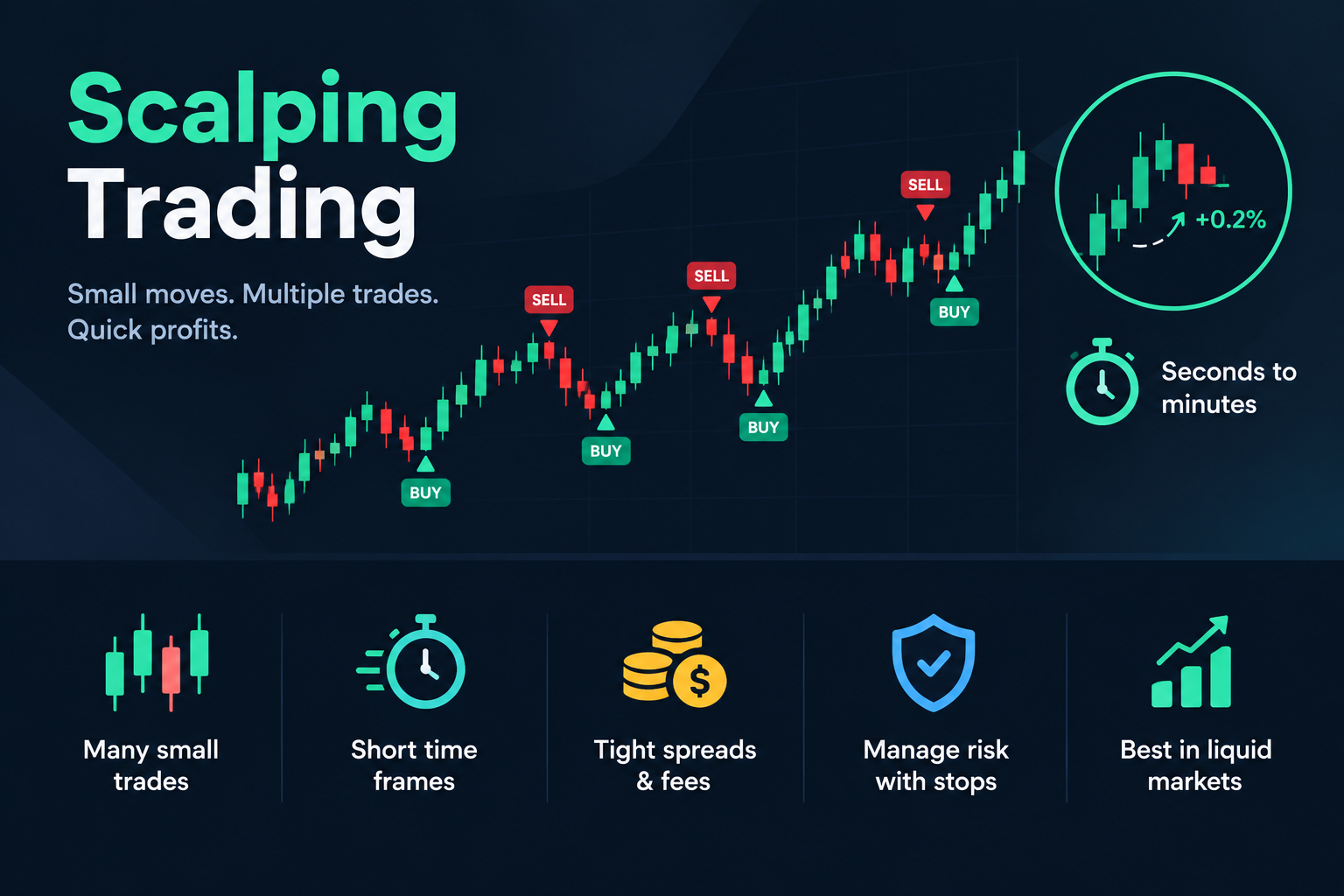
Scalping trading makes use of the volatility of the crypto market to open and close multiple positions within a short timeframe (seconds to a few minutes). The rationale here is to take advantage of small price movements rather than waiting for larger, infrequent moves.
Major Takeaways
Requires constant monitoring since positions only last a few seconds to a few minutes at a given time, but unexpected news can still affect the trade.
Scalping is suited for liquid markets with tight spreads
Spreads and maker or taker fees can take a meaningful portion of each gain
Position sizing and stop levels can limit damage when things do not go according to plan
What Is Scalping Trading?
Scalping trading meaning is straightforward. The trade has a narrow goal, and the scalper may exit as soon as the goal is met or the trade fails. Scalpers may use Candlestick charts and the order book to time when the entries and exits take place. Since crypto is a 24/7 market, scalpers choose their own sessions instead of market hours.
How Scalping Works in Crypto: Timeframes, Spreads and Execution
Scalpers monitor the 1-5 minute candlestick charts, preferably on a liquid asset on the spot market. Fixed profit target, and stop loss levels are set up before entry.
If a scalper desires a swift entry, he may establish a market order and be willing to pay the trading fees and spread, automatically designed between the best bid and best ask. Or the seller may bid for a limit order to have a trade handled when the limit is achieved.
Slippage is the difference between the price you wanted and the price you actually paid, and it can also add to the cost amount. Taker and Maker fees are determined by market orders and limit orders, respectively. Some traders are using bots, but they must still be supervised by a human.
Scalping Strategy Examples in Crypto
The scalping strategy of a trader is based on preference and market conditions. Common ones are
Range trading: The scalper looks for the best prices in between support (floor) and resistance (ceiling). The scalper buys at the lowest price close to the floor and sells at the highest price close to the ceiling. It depends on a specific benchmark and loses when breakouts occur.
Breakout scalping: The focus is right at the moment the price comes out of an already established support or resistance level. The scalper enters the trade right after a break in patterns. Works when markets move fast, and is prone to false breakouts when the price snaps right back to the earlier range.
RSI and moving averages: A scalper waits for indicators that signal momentum before committing. An RSI (Relative Strength Index) below 30 means the coins have fallen too fast, read as oversold, while an RSI above 70 means it has climbed up too fast, read as overbought. The crossover of the short-term and long-term averages serves as a second signal. Trends are clearer, but indicators are slow to respond to rapid price changes.
Is Scalping Profitable? Costs, Fees and Win Rates
Making money might be feasible; any profit will rely mostly on frequency rather than volume. Traders generally try to gain fractions of percentages, for instance, a trader desires a 0. 2% gain. Paying 0.05% at each way, he is left with a 0.1% gain.
Trading commissions and slippage can matter. Even on high win rates and tight stops, large losses can still wipe out any advantage. Markets play a role, with fast, high liquidity markets offering more opportunity and thin markets meaning more slippage.
Scalping Risks and Who Should Avoid It
Traders have to deal with fatigue, which can lead to bad trade decisions such as overtrading. Record keeping is also more tedious. Platform delays and outages make exits difficult, and thinly traded pairs; orders can misbehave because of insufficient liquidity. Beginners may find it hard to execute a strategy that requires constant decision-making. Traders who do not have the time to watch markets and can not sustain repeated losses may want to avoid scalping.
Scalping vs Day Trading: What Changes
Under Scalping, which involves setting up and closing trades within seconds to a few minutes, Day trading holds positions for hours but closes before the end of a trading day.
| Characteristic | Scalping | Day Trading |
|---|---|---|
| Trades per day | Frequent. | Generally Lower |
| Typical Holding Time | Seconds to minutes | Minutes to hours. |
| Time commitment | Very High, constant surveillance. | Only during trading cutoffs of choice. |
| Cost sensitivity | High | Moderate |
| Main Risks | Fees, Slippage, Overtrading | Intraday volatility, missing market stops |
How does scalping work in crypto?
Since crypto is traded 24 hours a day, a lot of its activity occurs in pairs (BTC/ETH), and a trader can use this to engage in multiple trades per day and get immediate feedback.
What are the risks of scalping?
Leverage amplifies risks of scalping, more so when trading on margin and derivatives. Even though trades are short-lived, sudden price changes can inflict significant losses.
Conclusion
Scalping trading captures repeated small gains, while fees and slippage take a share out of each trade. Rules are set and followed before entering, rather than looking at the long-term value of a coin. The constant attention and decision-making means that traders wth less screen time and experience may find it hard to adopt the strategy.
Create an XXKK account to explore crypto markets.
Check spreads and fees on XXKK before scalping.
Use position sizing and stop levels; scalping amplifies costs and mistakes.
