Order Book Crypto: Read Depth and Size Orders | XXKK
Order Book Crypto: Read Depth and Size Orders | XXKK
Learn how to read crypto order book depth, estimate slippage, size trades, and decide when to split large orders before execution.
Order Book Crypto: How to Read Depth and Size an Order
Quick Answer: To size a crypto order, you need to compare its quantity with available liquidity across the relevant price levels. Estimate the quantity-weighted average fill price, check expected slippage and consider splitting large orders when the book is too thin.
Key Takeaways:
How to compare order size with cumulative depth, not only the top price level.
Understand how to estimate average fill price before sending a market order.
Learn how you can set an acceptable slippage limit before choosing your order size.
Discover how to split large orders when appropriate, while accounting for fees and price changes.
Understand how resting depth changes and does not predict future price direction.
Trading crypto involves not only finding a good entry price but also having a better understanding of how much of your order the market can take without causing the price to move against you. In order to evaluate the liquidity that is available, to estimate the costs of execution and to decide whether or not to place your order all at once or to divide it into smaller parts, you can use a crypto order book.
This guide explains practical strategy that traders use prior to submitting an order, such as checking the depth and managing order book slippage.
Depth in One Paragraph
Market depth indicates the amount of buying and selling orders located at various price levels. When planning to enter a trade, the important question is how much liquidity is avalable between the present price and the highest price you are willing to take. Although a large order close to the top of the book may appear to be manageable, it is the total volume available at a number of different price levels that is more important when determining the size of a big trade.
If you want a recap of what bids, asks, spreads and depth charts are, check XXKK Academy’s How to Read a Cryptocurrency Order Book.
Reading Depth as Cost, Not as a Signal
The fact that there is a deep order book doesn't mean the market will move in a particular direction; its main advantage for execution is that it allows you to estimate the amount of liquidity available at various prices.
Imagine you wish to purchase 2 BTC. The highest ask prices available may be enough to cover only part of your order; the rest of the amount would have to be filled at higher prices if you place a market order and the order book remains the same.
The principle is just as applicable when entering bids. If the buy orders available are too small, your order could take up several price levels.
Before sending an order, check three things:
How much volume is available within your acceptable price range?
What proportion of the available liquidity will your trade use?
What is the present state of the market, is the book stable or are the prices and quantities undergoing rapid changes?
There is no single depth requirement applicable to all orders; a trade which is small in comparison to the nearby liquidity will usually have a smaller effect on the price than one which takes up a large portion of it. The appropriate size also varies according to the slippage you can tolerate and how quickly you need the order executed.
Estimating Slippage Before You Send
The difference between the price that you anticipate and the price at which your order is executed is known as order book slippage. Even though it enables you to make an estimate of this difference, checking the visible depth before placing a market order does not guarantee it.
Use this process:
Select the quantity of your order and decide how much cryptocurrency you would like to buy or sell.
Review the available asks for buy orders or bids for sell orders, then add the quantities across price levels until your order size is covered.
Work out the fill price by multiplying each of the quantities filled by their respective prices, then adding up the totals and dividing the sum by the total quantity filled.
Compare your reference price with the amount you expect to fill on average and calculate the difference between the two.
For instance, suppose you wish to buy 1 BTC. The outstanding asks indicate 0.4 BTC at $60,000 and 0.6 BTC at $60,100.
Your estimated average fill is:
(0.4 × $60,000 + 0.6 × $60,100) ÷ 1 = $60,060.
When the reference price is $60,000, the estimated price difference would be $60 per BTC, which is 0.1%. This does not include trading fees and is based on the assumption that the displayed orders stay available.
Carry out this check for various order sizes. When you increase your order from 1 BTC to 2 BTC and this causes the estimated average price to rise significantly, then the larger size will involve a higher execution cost.
If you want to know more about the mechanics involved in execution costs, see XXKK Academy’s order book guide.
Sizing and Splitting a Large Order
What depth is required for the amount you wish to order? First determine your maximum allowable slippage, then verify whether the visible order book can accommodate the quantity you intend within that slippage limit.
If the order you place takes up a large part of the liquidity found near the top of the book, then you should decrease the size or divide it into smaller orders. It makes sense to consider splitting when:
Compared to the depths around it, your order is large.
The sharper the estimated average fill becomes, the greater the size.
The market is moving rapidly or the liquidity is low.
You won’t need the whole position right away.
For instance, rather than placing a big buy order all at once, you could split it into smaller ones and check the market conditions between each execution. In this way, you can respond to changes in liquidity.
It doesn't follow that splitting will be cheaper. Prices could move against you while you are waiting, extra fees could build up and subsequent orders might get poorer fills. Although a limit order gives you control over the price, it does not guarantee that the order will be executed.
When you are trading perpetual contracts, you should bear in mind that contract exposure and liquidation risk are also important factors when deciding on the size of your position. The XXKK Academy sets out the differences between spot trading and perpetual contracts in its Perpetual Contracts guide.
Why Resting Depth Disappears
The fact that liquidity is visible does not mean that the order will stay there. Traders can cancel or alter their orders because prices move, new information becomes available, or their execution plans change.
Depth may also vanish since other traders carry out transactions against those orders. When periods of volatility occur, market makers and other liquidity providers usually change their quotes more frequently, which makes the order book less stable.
That is the reason why a depth snapshot should be regarded as a temporary view and the book should be checked again before placing a large order, in particular when the market is moving quickly.
What the Order Book Cannot Tell You
While an order book displays visible resting orders, it does not show all aspects of market activity and therefore cannot reliably inform you of:
The orders that are displayed will stay until your trade arrives.
One should consider whether a big order indicates real trading interest or whether it will soon be cancelled.
The total amount of orders that are hidden or reserved.
The direction in which the price is about to move.
The price at which the order will be executed if there are changes in liquidity before it is filled.
The fact that there is a thick wall of buy orders does not prove that the price will go up and similarly, the presence of a big sell does not ensure that there will be a decline. Depth should be used to plan when to execute, not as a tool for making standalone predictions.
Where to See Trade History on a Crypto Exchange
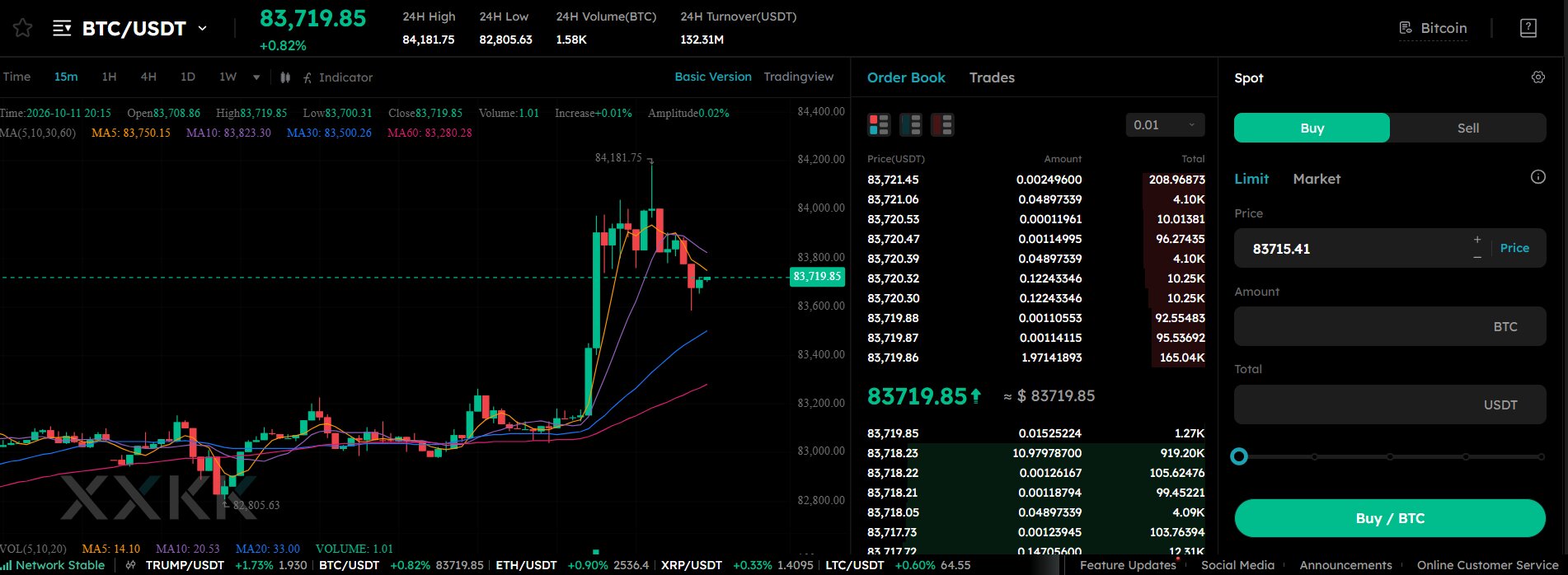 Source: XXKK Spot Market Page
The order book includes resting orders whereas the trade history shows those transactions which have been completed. By looking at recent trades you are able to compare the available liquidity with the actual trading activity.
On XXKK go to the Markets page, choose the trading pair you want, and then look at the order book, the depth chart, and the information on recent trades. Determine if trades are consistently taking place near the visible levels or whether the quantities shown change before they are executed.
To check the current depth before deciding on the size of your position, open an XXKK account. Before placing an order that could affect the price, look at the depth chart and consider splitting large orders in order to reduce the impact of your own trade.
Conclusion
When you are carrying out a trade by referring to the order book, you need to match the size of your order with the available liquidity. You should estimate the average fill price, compare it with the slippage you are willing to accept, and then re-evaluate the depth of the book before submitting a large order. If the visible part of the book appears to be too thin, it may be worthwhile to reduce or split the order.
Keep in mind that resting liquidity is subject to change; instead of depending on a single snapshot, use the order book together with recent trade history and your execution plan.
FAQs
How much depth do I need for my order size?
To do this, compare the total quantity available at prices near to your desired one with the size of your order and then make an estimate of the average fill.
How do you estimate slippage before sending an order?
Keep adding the amounts that are available at each successive price level until the total equals your order. Work out the quantity-weighted average fill price and then compare it with your reference price; regard the result as an estimate since liquidity can change.
When should you split a large order?
It is advisable to divide your order when the size of your order takes up a large portion of the nearby liquidity, when the estimated slippage increases as the size of the order grows, or when the market is volatile. You should also take into account the fees and the possibility of price changes between the times when the order is executed.
Why does resting depth disappear?
This happens because traders either cancel or alter their orders, while other participants carry out transactions using the available liquidity. Since prices often change quickly, this results in more frequent updates to the displayed depth.
