Largest Crypto Exchanges: How Rankings Work | XXKK
Largest Crypto Exchanges: How Rankings Work | XXKK
Learn how crypto exchanges are ranked by volume, users, reserves and liquidity, and how to verify exchange rankings before choosing a platform.
Largest Crypto Exchanges: How the Rankings Are Built
Quick Answer: The largest crypto exchanges are ranked using measures such as trading volume, user activity, reserves and liquidity. Rankings differ because different data sources and methods are used. Always check the methodology, reporting date, reserve disclosures, fees and regulatory information before relying on a ranking.
Key Takeaways:
Understand how exchange size depends on the measure used.
Discover how trading volume shows activity but does not prove strong liquidity or financial health.
Understand how proof of reserves does not automatically establish that all liabilities are covered.
Rankings differ because their data sources and methodologies vary.
Verify exchange claims using independent data, official disclosures, fee schedules, and regulator records.
When you look at the various crypto exchange tracking platforms, you will notice different rankings; for instance, one exchange might rank first on the basis of reported trading volume, while another exchange might rank first on the basis of liquidity, user activity or estimated reserves.
These differences exist because there are no unified ranking criteria for crypto exchanges. Once you know how a crypto exchange ranking is put together, you shall be able to compare the different platforms on the basis of evidence rather than just the headlines.
What “Largest” Actually Measures
The term "largest crypto exchanges" usually refers to exchanges that have a high trading volume, large number of users, significant amount of assets held by them or good liquidity for the different trading pairs.
Each measure answers a different question:
What is trading volume? In simple words, trading volume is the amount of trading activity the platform has over a specific period.
The number of Users: What is the number of registered or active customers the exchange has?
Which assets does the exchange claim that it is holding?
What does liquidity mean? It is the degree to which traders can buy or sell without the price of the market changing significantly.
What level of market coverage does the platform offer? This refers to how many trading pairs, assets and types of trades does it support?
A platform may be ranking high in one area while having a lower ranking in another, which is the reason why the largest crypto exchange in terms of trading volume is not necessarily the best choice for every trader.
Before you trust any ranking, you should find out what the publisher is measuring, which exchanges it includes and when the data was collected.
Ranking by Volume: What the Number Includes
Ranking by volume is one of the most commonly used method for comparing the leading crypto exchanges. This figure represents the total value of the transactions made over a specific period, usually 24 hours.
It is not always possible to compare volume figures directly since one ranking may consist only of spot trading while another includes both spot and derivatives trading. Although some reports focus on centralised exchanges while others include decentralised platforms.
The amount that has been reported also needs to be looked at since it might be affected by promotional trading, incentives, or transactions which don't indicate strong actual demand.
When reviewing a volume-based ranking, ask:
Does the entity cover the spot markets, the derivatives, or both of these?
Is the reporting period identical on all of the platforms?
Does the source make explicit the method by which it verifies the reported activity?
Is the data open to independent review or does it rely on a clear methodology?
Although volume can be helpful when comparing different levels of activity, it does not provide a complete picture because a platform with high reported trading volume may still have limited liquidity for a specific trading pair because volume and market depth measure different aspects of trading activity.
To give an example concerning a specific market, the XXKK Academy report on the Best Crypto Exchanges in India for 2026 mentions that when selecting an exchange one should take into account India's regulatory requirements, for instance the need for FIU-IND registration and tax considerations. The considerations involved here are concerned with a question which is different from that of global trading-volume rankings.
Ranking by Users, Reserves, and Liquidity
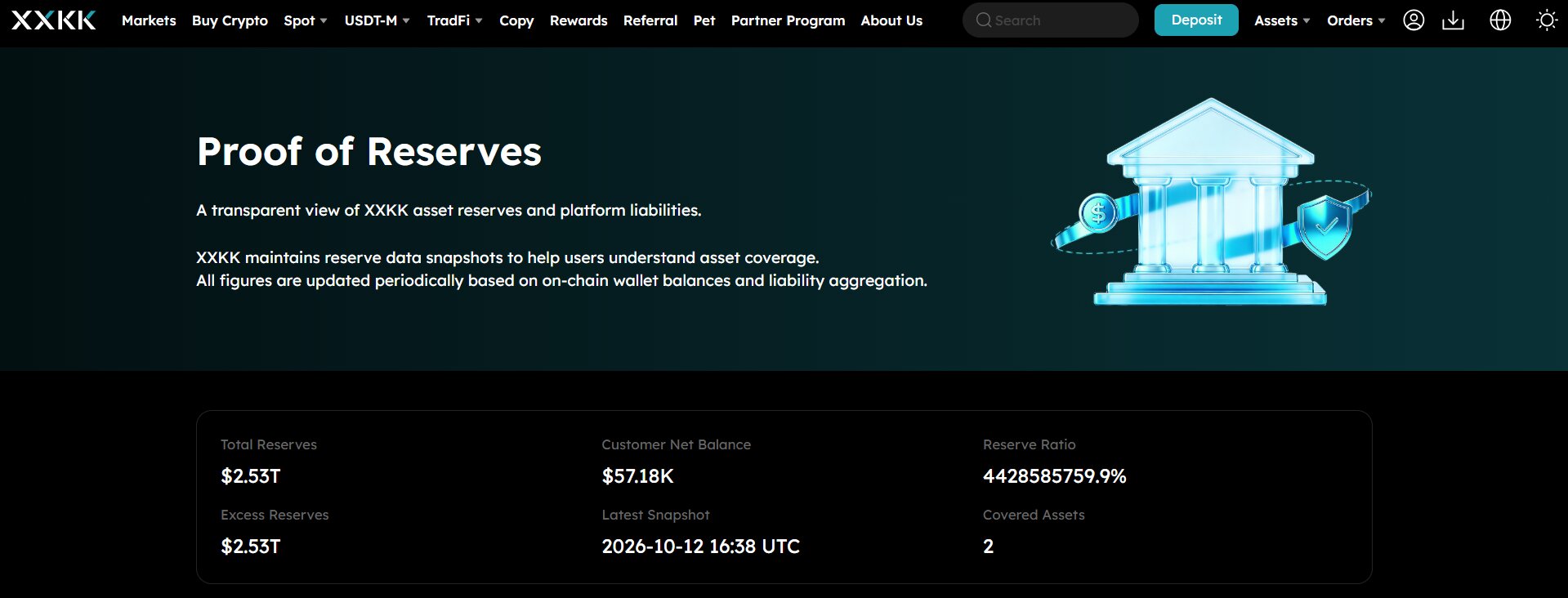 Source: XXKK Proof of Reserves Page
Other methods of ranking concentrate on the size and strength of an exchange apart from the trading activity that is reported.
The number of users: While registered accounts show the number of accounts that have been created, they do not show how many people trade regularly; active-user figures are more useful if the source makes clear what is meant by an active user and states the length of the period used for the measurement.
Proof of reserves: This refers to evidence which is meant to demonstrate that an exchange holds certain cryptocurrency assets at a specific point in time. Sometimes, cryptographic methods such as Merkle trees are employed to help users check that the balances on their accounts are included in the published snapshot.
Although proof of reserves can provide evidence that an exchange holds certain assets, it does not by itself prove that the exchange is financially sound because it may not cover all liabilities, borrowed assets, off-chain obligations, or restricted assets. In order to make a proper assessment it is also necessary to consider how the liabilities are reported and whether independent assurance can be obtained.
Liquidity is the degree to which an asset can be traded without leading to a large change in price. When trading, people generally consider the bid-ask spread, the depth of the order book, and the impact of an order on the price. These factors are important when comparing the real trading experience on various exchanges.
A platform might have a small number of users but still offer better liquidity for a particular pair, the result depends on the market in question.
Why Rankings Disagree With Each Other
Different ranking lists often come to different conclusions since the companies that produce them use different data sources, time periods, and scoring methods.
One provider could rank the exchanges according to their estimated spot volume. Another might give scores based on liquidity, cybersecurity, regulatory information, and market coverage. One could focus on regional access and compliance.
The rankings are also influenced by changes in the level of trading, by the opening of new markets, and by developments in the regulatory area. A list which was published many months ago might no longer reflect the current situation.
The concept of "the best crypto exchanges" is very subjective because a beginner might prefer simple trading tools and clear fees, while an experienced trader will place more importance on derivatives markets, liquidity, and the various order types.
It is necessary to read the methodology before considering a ranking to be a definite result.
How to Verify an Exchange Claim Yourself
Do not base your assessment of an exchange solely on one ranking platform; rather, you should carry out several checks to evaluate it. You can utilize platforms such as Coinmarketcap or Coingecko as part of your research tools.
Always check for the original source, find the organization or agency which carried out the ranking and confirm the date on which it was published as well as the period over which the measurements were taken.
Try to compare different metrics; it is important that the figures relate to the same markets, products, and time periods.
Review the trading conditions: Check the exchange’s fee schedule, available trading pairs and order book depth. XXKK’s Markets page is one place to review its listed markets.
Check the reserve disclosures: Make sure you note the date of the report, the assets included, the method of verification and the information regarding the liabilities.
See the regulatory information and check the claims regarding licensing or registration by referring to the official records of the relevant regulator. Although, the requirements vary from country to country.
Check independently for confirmation: You should compare the claim with data from other reliable data providers and with the previously published information by the exchange.
For an introduction to spot trading activity, see XXKK Academy’s Spot Trading Basics.
Choosing an Exchange on Criteria That Matter to You
An exchange ranking must be seen as only a first consideration and not as the final decision. While you are carrying out your evaluation, you should take into account the features which affect your trading activities, for example the fees, the liquidity available for the currency pairs you prefer, the types of orders offered, the security measures used, the terms concerning withdrawals and the regulatory status in your own jurisdiction. The aim is to make a decision on the basis of information that is verifiable rather than depending on a position in a ranking list.
Conclusion
The popular crypto exchanges are judged using criteria such as trading volume, the number of users, reserves and liquidity, since each of these factors reflects a different aspect of the exchange's size and level of activity.
If you are assessing where a crypto exchange ranks, you should examine its methodology, trading data and verify its main claims yourself. A single figure never provides a complete picture of the exchange's reliability or suitability.
FAQs
What are the largest crypto exchanges?
When evaluating an exchange, using criteria like trading volume, user activity, reserves or liquidity is important. The result, however, will depend on the specific measure and data source used in the ranking.
How are crypto exchanges ranked?
The rankings are based on a range of factors such as trading volume, liquidity, the number of users, the value of the assets held, security information and regulatory status. Each publisher determines its own methodology and the method it uses for assigning weights.
Is trading volume a reliable measure?
Trading volume can be used as a way of estimating level of market activity, but the figures reported may be based on different definitions or may include transactions that do not show real demand. It is necessary to compare the methodology and also check the liquidity.
What is proof of reserves?
Proof of reserves is evidence that an exchange has certain assets at a particular time; it does not in itself prove that all of the customer liabilities are covered or show the exchange's full financial position.
