Permissioned Blockchain: Who Can Read and Write
A permissioned blockchain restricts who may read, write or validate. Here is how access control works and how it changes the trust model.
Quick Answer
A permissioned blockchain restricts who can read records, submit transactions or validate activity on a network. Organizations or consortiums assign permissions based on defined rules, helping manage access to shared records. However, this control comes with trade-offs in transparency, governance and reliance on approved participants compared with public blockchains.
A permissioned blockchain is a blockchain network that restricts participation to approved users or organizations. Administrators define who can read records, submit transactions or validate blocks based on assigned permissions.
Major Takeaways
Understand how permissioned blockchains restrict reading, writing and validation to approved participants.
Recognize that validator permissions determine who can confirm transactions and maintain network agreement.
Compare permissioned and public blockchains based on transparency, privacy, governance and trust requirements.
Evaluate whether a private ledger offers enough benefits to justify its technical and administrative costs.
A permissioned blockchain is one where participation is restricted to approved participants. Network operators can thus control who is allowed to read the records, who can submit transactions and who can validate the activity. This can be a good fit for an organization that wants to enforce access rules and have a shared record, though there are necessarily trade-offs in terms of openness, governance and trust when compared to a public blockchain.
Defining Permissioned Access
A permissioned blockchain is a distributed ledger where participation is permissioned rather than open to all. An organization or group of organizations will define the rules for who can join the network and what they can do.
A private ledger restricts access to approved participants, allowing organizations to manage who can view records, submit transactions, or validate activity according to established network rules. Unlike many public blockchains where you can just get in and do whatever the rules of the network allow you to do, permissioned networks require some form of approval for some or all of the activities. Permissioned doesn't necessarily mean that everything that happens on the network is private. Some networks will allow very broad read access while restricting access to transaction submission and/or validation.
Read Access, Write Access, Validate Access
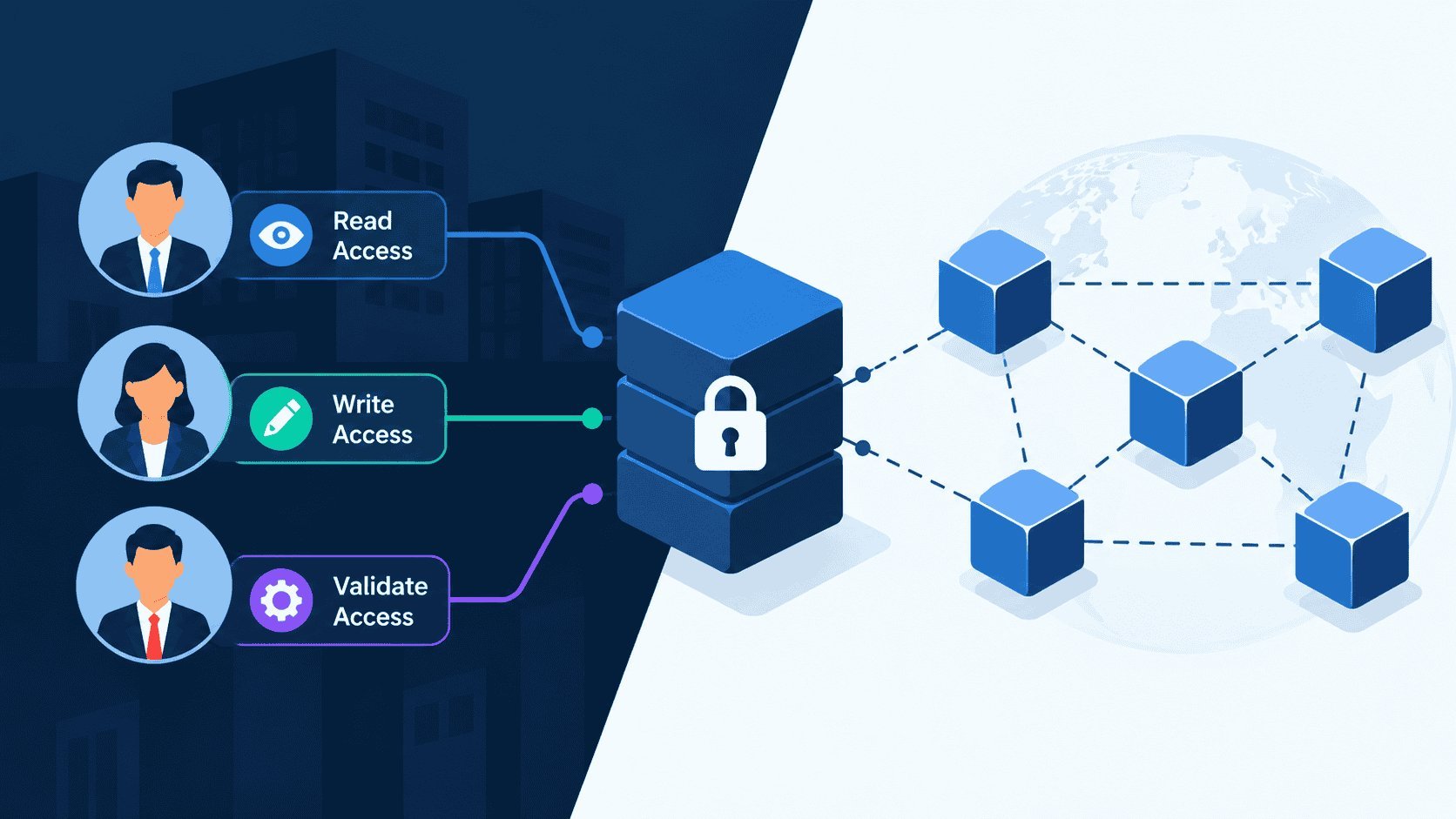 Caption: Permission Blockchain Illustration
Alt text: Permissioned blockchain showing controlled read, write and validator access across a connected network.
An access control blockchain breaks down permissions into different roles. These roles in question determine how the participants interact with the ledger.
Read access: enables the user to view the records they are permitted to see. This can be public access or access that is restricted.
Write access: Enables approved users to submit transactions or propose updates.
Validation access: enables designated participants to validate transactions and thus assist in maintaining agreement on the state of the ledger.
A network could allow customers to view transaction records while restricting data entry to approved suppliers and validation to selected organizations. Validator permission is of course critical as it determines who is permitted to participate in the process of validating transactions. The precise mechanism will of course be dictated by the blockchain's consensus mechanism and governance rules.
Who Holds the Keys to the Network
The organization that sets up a permissioned blockchain (the consortium) will usually be the one to define the membership and access rules. The administrators will be the ones to approve participants, assign roles, revoke access and manage identity credentials.
Common permissioned blockchain use cases include supply chain management, financial recordkeeping and business identity verification, where organizations need to control network participation and access to shared data. Access controls don't eradicate all the risks. Admins can make mistakes, credentials can be compromised and authorized users can supply incorrect information.
If you are exploring cryptocurrency platforms, see our guide to best crypto exchanges in India. To understand how assets are bought and sold on exchanges, read what is cryptocurrency spot trading.
Trade-Offs: Speed and Privacy Against Openness
Permissioned networks can of course restrict participation to known participants and that makes it much easier to control access to sensitive business information. You could have a much smaller, defined group of validators which would in turn make coordination much easier and result in much more predictable transaction processing.
However the benefits are all down to how it's implemented. A permissioned network isn't necessarily any faster or more secure than a public blockchain.
Public blockchains enable greater participation and allow individual users to verify activity in accordance with the network's rules. Permissioned networks can restrict that kind of independent verification and you have to be clear as to who has the power to grant access and how disputes are to be resolved.
Governance and the Single Point of Failure
A permissioned network can give rise to concentration risk if one organization controls the membership, the validation or the upgrades. If that organization fails, abuses its position or goes offline the network is in trouble.
A consortium can of course spread the work across a number of members, but shared governance brings its own set of problems. You need agreement on software changes, access policies, how disputes are to be resolved and how recovery is to be achieved.
Choosing Between Open and Permissioned
A permissioned blockchain would be appropriate in a scenario where you have participants who need to have shared records but where you also need to have control over who can view and who can edit those records. A public blockchain would be the preferred option in a situation where open participation and independent verification are key.
For a straightforward process that is governed by a single trusted organization, a traditional database may well be the cheaper and simpler option to maintain. Always compare the options against the actual trust issue before you go down the blockchain route.
To learn about the current crypto market, visit XXKK Markets and if you would like to trade available cryptocurrency create an XXKK account.
Conclusion
A permissioned blockchain is one that controls who can read, who can write and who can validate the records. It can be very useful in some shared business processes. The trade-off of course is in openness, governance and your dependence on the approved participants. Pick the access model that is right for you rather than assuming that permissioning is the natural progression.
FAQs
What is a permissioned blockchain?
A permissioned blockchain is a distributed ledger which restricts certain actions to a pre-approved set of participants. Depending on the design of the system it may restrict who can view the records, who can submit transactions and who can validate the blocks.
Who decides who can validate?
The governing body or consortium of the network will normally be the one that decides who gets to validate the transactions. Their rules will cover the process of approving, removing and monitoring of validators. Some networks will have a single administrator with this power while others will require agreement from a number of members.
How does access control work?
Access control is all about identities, credentials and permission rules to work out what actions a participant is allowed to carry out. A user may be permitted to view records without being allowed to submit transactions, whereas validators will have a further set of permissions. The roles are managed by the administrators or consortium members in accordance with the network's policies and can be revoked as required.
What are the trade-offs versus a public chain?
Permissioned blockchains enable controlled participation and can provide for restricted data access, though they may also restrict the ability to independently verify and can lead to centralization of decision-making. Public blockchains in principle allow for a much broader degree of participation under an open set of network rules.
Is a permissioned chain still a blockchain?
Yes, a permissioned chain can still be a blockchain if it maintains a sequence of linked blocks or equivalent blockchain structures using agreed rules to validate and record transactions.
