The Psychology of a Market Cycle: Greed to Capitulation
The Psychology of a Market Cycle: Greed to Capitulation
Demystifying market cycle psychology in crypto. Learn how collective emotions shape price action, why capitulation isn't a market bottom, and how to trade based on a pre-planned strategy rather than crowd sentiment.
The psychology of market cycle is a concept of how a multitude of emotions, not just price, change as a market rises and drops. These feelings usually move from skepticism to growing confidence to euphoria, then denial to capitulation. Sources suggest that collective sentiment can influence prices, but there is no fixed validated sequence that the cycle has to follow. Market psychology is a real, studied phenomenon. The emotional components, which vary from six to thirteen, are conventions, not scientific law. Herd mentality, traders influencing one another and assuming trends would move in a certain way, is a key mechanism of sentiment shift. Capitulation is the period of large selling and lack of confidence in market conditions, not the bottom state of the market itself. A chart can illustrate a stage after the fact. It can't reliably identify one while it's happening. Immediate reactions once a stage is underway tend to be less useful than planning a response in advance. Overall investor predisposition towards the current market, general mood, and predictions shared amongst traders can affect natural price movements. Noise trading research in 1990 gives an outlook on how emotion-driven demand affects prices when exploiting price differences becomes challenging. Herding mentality gives another reason why sentiment has a widespread effect. Most traders would follow the decisions of others rather than making their own decisions, which influences buying and selling pressure. Extrapolative expectations are when traders assume that a current market trend would continue indefinitely. Research from the US housing market found that long-term price expectations kept on rising more than mortgage rates could handle, just as the market peaked This doesn't mean that emotion is an all-powerful force or the only thing that can move the market. Interest rates, liquidity, and regulatory practices all matter, but human sentiment is a well-documented influence. There are six phases of market cycle psychology; these come from a framework called the Wall Street Cheat Sheet, which was already available online by 2019. The full version then lists 13 stages, adding belief, thrill, complacency, anxiety, panic, anger, and depression. Other frameworks use four phases based on accumulation, distribution, markup, and markdown. None of these models is official or standard; rather, they are different interpretations of the same idea. Disbelief: Doubting early signs of market recovery after a previous decline Hope: Believing that the market is favorable without much evidence. Optimism: Growing positivity that market improvement will be long-lasting based mainly on increased participation Euphoria: Widespread optimism and predicting gains with exceptional percentages. Denial: Dismissing a change in market trend as a temporary setback Capitulation: Widespread pessimism and exhaustion after continuous losses that comes with increased selling pressure as traders lose confidence. There is no universally accepted threshold, price move, or volume level shown to confirm one emotional label. What shows instead are recognizable patterns associated with each stage, not conditions that have to occur. The Oct 19, 1987 crash, where the Dow Jones Industrial Average fell 22.6% in a single day with sell orders outnumbering willing buyers at prior prices, provides genuine evidence of market-wide selling pressure. Yet it doesn't mean that capitulation is what caused this market shift. Sentiment and price action are two different things. A trading volume hike shows the activity, not what caused it. Emotions influencing the trends are studied separately through surveys or positioning data, and they don't always move together. A 1975 study that dealt with hindsight bias found that once people know the final outcome of an event, they believe it to be more predictable than it actually is. A conclusion that was later confirmed again in 2021, suppose we were to apply that concept here. It means that completed or crashed markets make their obvious stages be completely revealed only in retrospect. The market is moving, but clarity doesn't exist yet. Sentiment surveys offer a different view; a popular example inquires about the expectations over the next six months and publishes weekly, a measurement horizon that doesn't match "what stage are we in right now." Different indicators: price, volume, surveys, and social data measure different things on different timelines, and surveys show that adding them together to get a real-time label isn't that useful. A handful of practices can help traders. These include having a clear-cut goal, limiting risk, documenting an intended allocation in advance, and having decisions put in place rather than just reacting because the mood has shifted. Notice when Euphoria is starting to set in, with the absence of hard evidence. This can be in the form of social media hype, urgency to buy, fear of missing out. At this phase, slowing down and setting limits can help. None of these guarantees a desired outcome, but it means a decision would be made before the crowd mood, not during it. XXKK's markets page offers a simple way to observe price and volume data directly, without relying on emotional news telling. With order types like limit and stop orders, you can formulate your plan in advance. Neither completely reduces execution risk, but can be useful when trading. Six emotional stages are a convenient way to discuss a phenomenon in trading. Collective sentiment does change with prices; herding and extrapolation are reasons why it occurs. But they aren't diagnostic tools; a chart can only be read after an event has occurred, not while it is still moving. Open an XXKK account to act on a plan instead of a feeling. Set your levels on XXKK before sentiment takes over. Write your rules in calm markets and follow them in volatile ones. It explains how the herd and expectations change as the market changes. Six common stages: disbelief, hope, optimism, euphoria, denial, and capitulation. Other frameworks describe different stages; there is no standardized number. Heavily discouraged, overlaid with a feeling of not knowing, with persistent losses, sometimes with aggressive liquidation. Refers to the sentiment rather than an actual low in the markets There is no trustworthy real-time indicator of stages. Price, volume, and sentiment each give clues.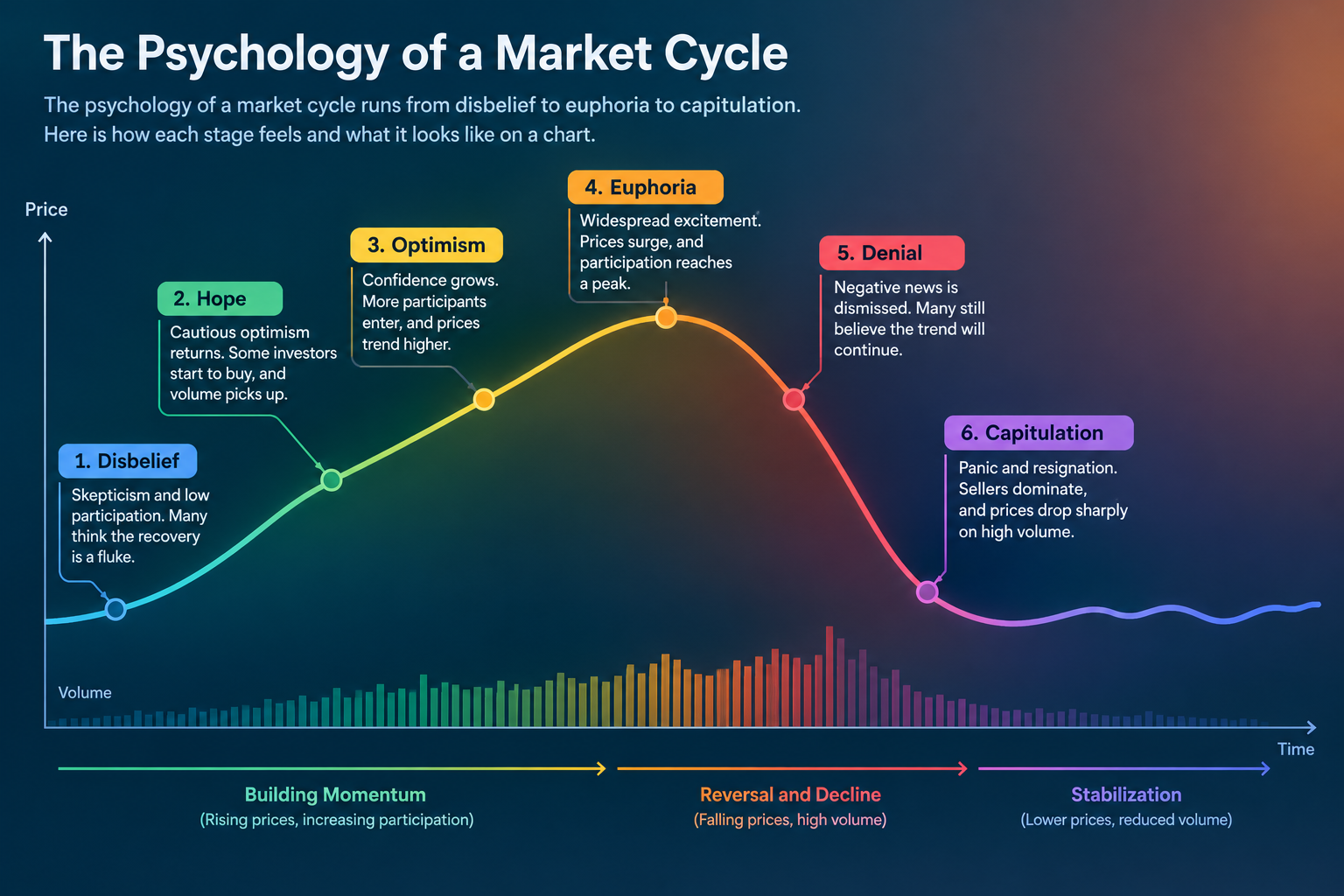 Quick Answer
Major Takeaways
What the Psychology of a Market Cycle Describes
The Stages: Disbelief, Hope, Optimism, Euphoria, Denial, Capitulation
What Each Stage Looks Like on a Chart
Why You Cannot Identify the Stage in Real Time
Rules That Survive Every Stage of the Cycle
Using XXKK to Keep Sentiment Out of Execution
Conclusion
FAQs
What is the psychology of a market cycle?
What are the stages of a market cycle?
What does capitulation feel like?
How do you know which stage you are in?
